Vendor SBOM Validation After a Supply Chain Incident
Validate vendor SBOMs before a breach forces you to rely on incomplete paperwork.

A vendor SBOM tells a security team one thing: what the vendor declared. The gap between holding a document and being able to use it under pressure is the subject of this piece, and it is a gap most organizations do not discover until the moment they need the SBOM to answer a question it was never built to answer. The supplier SBOM problem is an operating model problem that runs through procurement, product security, legal, compliance, engineering, and incident response at the same time, and no single team owns enough of that chain to fix it alone.
The trouble starts well before any incident occurs. A file in that condition was never fit for operational use, and the team that reaches for it under pressure finds that out at the worst possible moment. A vulnerability's discovery raises the questions fast: which internal products include the affected component, which supplier products include it, which suppliers have already provided SBOMs, which suppliers are actually affected, which have issued VEX statements or remediation guidance, which customers require notification, and which regulatory deadlines now apply. None of those questions get answered by confirming that a file arrived in an inbox.
"We received the SBOM" is a weak measure of preparedness. The test that matters operationally is whether the document can answer risk questions by machine, matching component identities against vulnerability databases and producing a scoped answer in minutes rather than requiring a human to read through a spreadsheet of partial fields. The rest of this piece lays out the validation workflow that closes that gap: how to triage scope before opening a single file, how to check whether a declared SBOM actually reflects what was deployed, how to route confirmed exposure to the right vendor, what to demand once exposure is confirmed, and why none of it holds together without reproducible builds underneath it.
What a supply chain incident looks like at the moment it triggers vendor SBOM review
Supply chain incidents that trigger a vendor SBOM review tend to follow the same basic shape. The difficulty is not spotting that a compromise occurred. The difficulty is reconstructing, after the fact, exactly which builds pulled the bad version and which vendor SBOMs can even speak to that window of time.
Three attack patterns now dominate the incidents that force this kind of review. The second is CI/CD pipeline exploitation, where attackers target build infrastructure to compromise the packages it produces. The GhostActions campaign compromised GitHub user accounts to inject malicious GitHub Actions workflows that exfiltrated secrets, including npm tokens, putting npm packages at risk, though no subsequent attacks across npm were confirmed from those stolen tokens.
Each of these patterns shares a trait that makes after-the-fact validation hard: the compromise does not announce itself at the moment a bad version gets pulled. The keyv/cacheable incident, tracked as keyv-shai-hulud, began on August 4, 2026, when a self-propagating worm started publishing malicious versions of the npm packages keyv and cacheable along with their common dependencies, and the list of affected packages grew through the day as the worm spread. That spread pattern is why transitive dependency data matters so much in a vendor SBOM: a flat list of direct dependencies will not show a validator that a compromised package arrived three layers deep.
Environment drift makes every one of these scenarios worse. When builds are not reproducible, the artifact that actually ran in production may differ from what the vendor's SBOM describes, so even a well-formed SBOM can point a validator at the wrong target. That is the condition the triage step below has to work within, not around.
Triage: determining scope before opening any SBOM file
The first move in post-incident SBOM validation is building a scoped inventory of which vendors supplied which components to which products, so that the validation effort that follows is aimed at documents that can actually change a decision.
A handful of questions set that scope. Which internal products or services were built using the affected component or its ecosystem? Which vendors supplied components within that ecosystem, and which of those vendors have provided SBOMs in the past? Which SBOM files already on record were generated close enough to the incident's triggering release to speak to the current situation, and which are leftovers from old builds that cannot? Which vendors never responded to prior SBOM requests at all, leaving an outright gap in the evidence base?
If SBOM request tracking is scattered across inboxes, procurement notes, security tickets, and spreadsheets, this scoping step becomes the bottleneck on its own, before any technical validation even starts. A workable supplier SBOM process needs a system of record that captures which supplier was asked, which product the request covers, which SBOM version came back, and what follow-up remains open. Without that record, triage turns into an archaeology project at the exact moment speed matters most.
The output of triage is a prioritized vendor list, not a validated conclusion. Vendors whose components are confirmed or probable matches to the incident's attack vector move into active validation first. Vendors whose components sit in adjacent ecosystems move to a watch list pending further information. Vendors with no SBOM on record at all move straight into an emergency request queue, because the absence of a document is itself a finding that has to be tracked and closed.
Checking whether the SBOM reflects what ran
A vendor SBOM only passes post-incident validation if it can be reconciled against what was actually built and deployed. A document that lists declared intent but cannot be matched to an artifact hash or a build output does not function as evidence. It functions as paperwork, and paperwork does not stop an exposed deployment from staying exposed.
Reconciliation depends on a specific set of fields. Component hash and hash algorithm matter because hash-level matching is the only reliable way to confirm artifact identity. That is why the CISA minimum elements, which replaced the NTIA 2021 baseline on July 29, 2026, added Component Hash Value and Component Hash Algorithm as required fields. Unique identifiers in the form of purl or CPE matter because without them, vulnerability matching against CVE databases produces both false positives and missed matches, and security teams end up spending their time resolving disagreements between tools instead of confirming real exposure. SBOM Author Signature, added as a new field in the CISA 2026 minimum elements and defined as a digital signature attributable to the SBOM author, matters because it is what lets the document's provenance be verified.
These failure modes appear constantly at this step. And some are technically valid CycloneDX or SPDX files that pass a format check while leaving the fields required for machine-readable risk queries empty.
Where an SBOM cannot be reconciled to an artifact, that gap needs to be written down explicitly. It becomes part of the incident record, and it triggers the vendor re-engagement that the next two sections cover.
Mapping exposed components to the vendors responsible for them
Once a component is confirmed present and potentially affected, the SBOM needs to identify the supplier responsible for it. Without that mapping, remediation requests land at the wrong company or at no company at all, and every day spent chasing the wrong contact is a day the exposure stays open.
This is where the supplier or software producer field does its real work. NTIA's 2021 baseline listed it as Supplier Name; CISA later renamed it to Software Producer and then, in a further revision, to Component Producer; FDA's 2025 guidance incorporates the same field through the NTIA minimum elements. When that field is missing, a validator has to reconstruct ownership manually from package registry metadata, contract records, or procurement history, and that reconstruction work delays response exactly when speed is the point.
A single vulnerable component frequently appears in SBOMs from multiple vendors at once, and each of those vendors has to be contacted and tracked separately as its own resolved case. As responses start coming back, they fall into a few recognizable states: a vendor confirms the component is present and affected; a vendor issues a VEX statement asserting the component is present but not exploitable in their specific product context; a vendor simply does not respond, which becomes an escalation item for procurement; or a vendor requests an NDA or otherwise restricts disclosure before sharing an updated SBOM.
That last state is a known friction point, not a surprise, and it needs to be anticipated rather than improvised. A controlled disclosure policy, one that defines what is public, what requires authentication, what requires an NDA, and what gets redacted, has to exist before an incident occurs. Negotiating those terms for the first time in the middle of a response wastes time that the organization does not have.
What to demand from vendors once exposure is confirmed
A confirmed exposure without a structured commitment from the responsible vendor is just an open finding sitting on a list. The validation workflow only pays off when it produces specific, trackable remediation obligations that someone can be held to.
A handful of commitments should be treated as the minimum bar once exposure is confirmed. An updated SBOM reflecting the patched release, carrying both a generation timestamp and a hash that can be verified against the new artifact. A VEX statement or patch advisory that names a specific CVE reference, an affected version range, and a fixed version, rather than a generic statement that the vendor is investigating. And confirmation that the updated artifact's hash has been shared, so deployment-level blocking or patching decisions can proceed from hash lookup rather than rescanning every affected image from scratch.
The regulatory backdrop gives these demands some weight. CISA's 2026 minimum elements require SBOM Author Signature and Component Hash, so a vendor's updated SBOM has to carry those fields to be compliant with the current standard, and a validator can point to that standard directly when pushing back on an incomplete response. An active incident is the moment to document that gap concretely and push the contract update through, since the argument for the clause is sitting right in front of everyone involved.
None of this holds up later without a record. Every vendor response, every VEX statement, every updated SBOM, and every commitment needs to be logged with a timestamp, because regulators, customers, and internal governance all need evidence that the incident was actually managed, not just that it eventually went quiet.
Why the validation process breaks without reproducible, hash-anchored environments
Every step described so far, reconciling SBOMs to artifacts, confirming component versions, matching hashes, issuing deployment-level blocks, depends on one premise that a lot of organizations cannot satisfy: that they know what was built and when. When that premise fails, the whole workflow fails with it, regardless of how well-formed the vendor's SBOM turns out to be.
CI/CD pipeline drift is the mechanism behind that failure. It is the gradual mismatch between the build process an organization intends to run and the one that actually runs, and it means that even a perfectly accurate vendor SBOM can describe a build that no longer matches the organization's own artifact. A different base image digest, a transitive dependency that floated up to a new version between builds, a build-time flag that differs between staging and production: any one of these makes hash-level reconciliation impossible, because the hash the validator computes from the deployed artifact no longer matches the hash the SBOM describes.
Reproducible builds solve this at the root. When every input to a build is pinned and the output can be deterministically derived from those inputs, hash-anchored SBOM validation has something solid to stand on. Teams that manage their environments through declarative, pinned manifests, where every package reference is locked to a specific version and hash and every change is atomic and auditable, can generate SBOMs that are structurally accurate to the artifact that actually ran, not just to declared intent at build time. Teams without that discipline are left reconstructing what ran from logs after the fact, a slower and more error-prone process under the pressure an incident creates.
The payoff of getting this right is measured in time. Input-derived hashes attached to deployments make it possible to identify which deployments are affected by a given CVE through a direct hash lookup. That shift compresses the triage-to-block or triage-to-patch cycle from a matter of days to a matter of hours, which is the difference between an incident that gets contained and one that keeps spreading while the validation work catches up.
Building the post-incident process so it does not have to be invented again
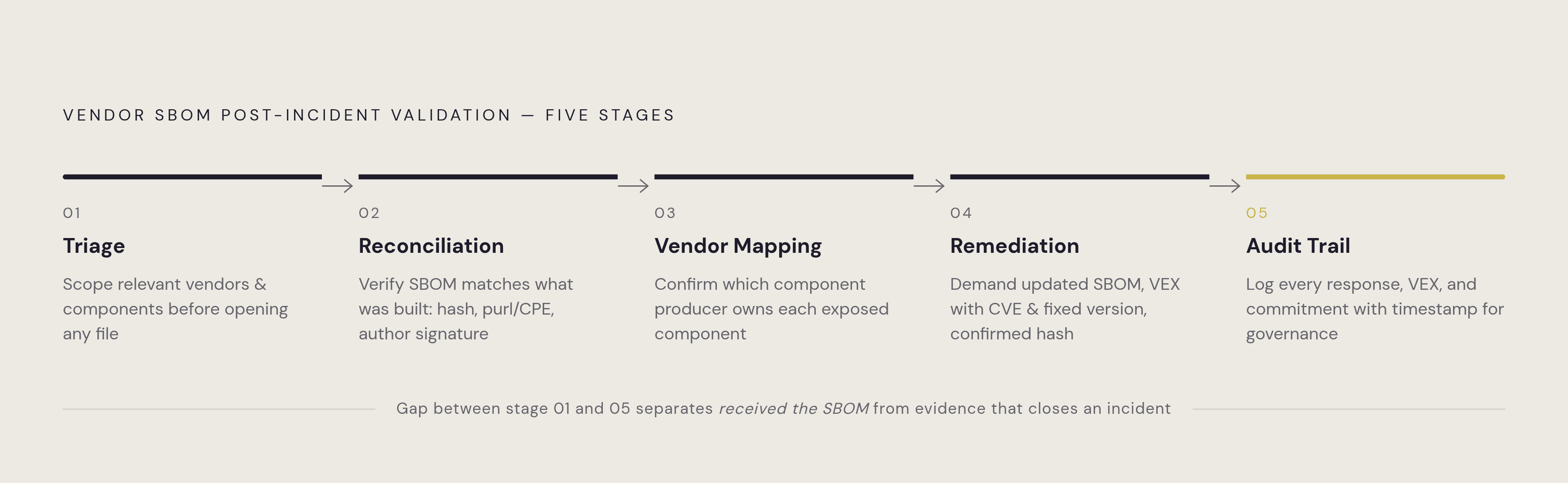
The workflow described here, triage, reconciliation, vendor mapping, remediation demands, audit trail, only earns its value if it gets built once as standing infrastructure rather than reassembled from scratch during the next incident. That means a system of record for every SBOM request and response, a reconciliation checklist that gets applied the same way every time, a disclosure policy with NDA and redaction terms settled in advance, and contract language that bakes remediation SLAs and required SBOM fields into every vendor relationship before anything goes wrong.
The regulatory calendar makes this more than a convenience. Organizations that wait for the next incident to build this process will be building it against a deadline that has already started running. Treating vendor SBOM validation as a standing operating model, not a one-time scramble, is what turns a document into evidence, and evidence into a response that actually closes.