SBOM Requests in Enterprise Software Vendor Questionnaires
Log4j showed enterprises they need component transparency from software vendors.
Software bill of materials requests started showing up in enterprise vendor security questionnaires because a string of incidents and new rules turned component transparency into a condition of doing business. Log4j is the event that made the case directly. A small logging library, buried inside thousands of commercial products, turned out to carry a critical vulnerability discovered by security researchers in late November 2021 and disclosed publicly on December 9, 2021. The fix itself was straightforward once a vendor knew where the library sat in its stack. Finding out where it sat took most organizations far longer than fixing it, a gap the Cyber Safety Review Board documented in its study of the incident.
The policy response came fast. Executive Order 14028, issued May 12, 2021, directed the Department of Commerce to publish minimum elements for an SBOM and told NIST to issue guidance on software supply chain security. A federal oversight agency followed with memoranda requiring SBOMs from software vendors selling into the federal government, and procurement offices began writing that requirement into contracts. Europe moved in the same direction through binding law rather than executive guidance. The Cyber Resilience Act applies to any manufacturer placing a product with digital elements on the EU market, regardless of where that manufacturer is based, and its vulnerability and incident reporting obligations took effect September 11, 2026.
Each of these actions reinforced the others. A hospital system buying diagnostic software now expects the kind of component disclosure the FDA has pushed into medical device review. A bank evaluating a payments vendor expects the kind of traceability that PCI DSS and the CRA both assume. None of this activity stayed confined to regulators and federal contracting officers. CISA's 2026 Minimum Elements, published July 29, 2026, names its intended audience as organizations that produce software, procure software, or operate software. The document was written as much for an enterprise buyer drafting a questionnaire as for a federal agency writing a solicitation. The SBOM row in a vendor questionnaire is downstream of all of this. It is what happens when incident response, executive policy, and binding EU law converge on the same conclusion: a vendor that cannot describe what is inside its software is a vendor whose risk a buyer cannot actually assess.
What the CISA 2026 minimum elements require
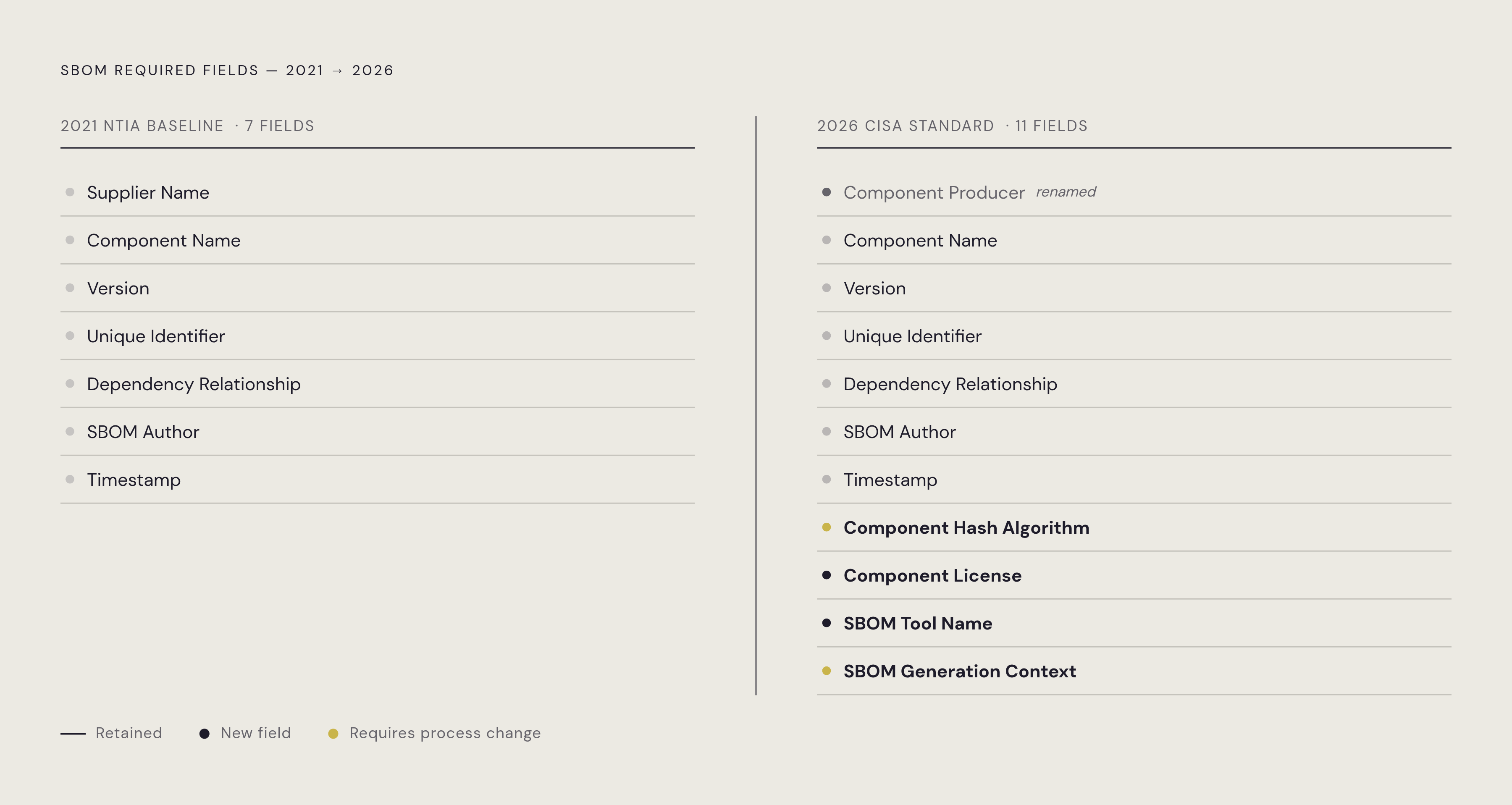
CISA's 2026 Minimum Elements replaced the 2021 NTIA baseline rather than simply updating it at the margins, and the gap between the two documents matters to anyone answering a questionnaire today. The 2021 baseline asked for seven fields: supplier name, component name, version, a unique identifier, the dependency relationship, the SBOM's author, and a timestamp. That list was adequate for a moment when few organizations had working tooling to produce an SBOM. Five years changed that picture completely, and the 2026 document reflects an industry that has moved from "can you generate one" to "can you prove it's accurate."
The new baseline adds component hash algorithm, component license, SBOM tool name, and SBOM generation context as required fields. It also renames "Supplier Name" to "Component Producer," a small wording change made for consistency across a document that now has to describe open-source projects and internal engineering teams as well as commercial vendors. The scope widened too: the 2026 elements apply to all software types, explicitly including open-source software, AI software, and software-as-a-service, with certain types needing fields beyond the baseline.
Two of the additions carry more operational weight than the others. The component hash turns a name-and-version record into a verifiable fingerprint of the actual bytes shipped, closing a gap that name-and-version checks alone cannot close. The generation context records where in the software's lifecycle the SBOM was produced, whether from source code, from a build process, or from analysis of a finished binary. An SBOM generated from source and one generated from the installed artifact will frequently disagree, and that disagreement tells a buyer whether the document in hand reflects what actually shipped or only what the source repository looked like at some earlier point. Both additions require a vendor to change how SBOMs get made, beyond what gets typed into a form. A vendor still operating on 2021-era practice, producing a static document with seven fields and calling it done, is behind the standard a well-briefed procurement team will now apply.
The six underlying concerns a procurement team is probing with SBOM questions
An SBOM question on a vendor questionnaire is a proxy for something the buyer actually wants to know, and the document itself is only evidence toward that answer. Understanding what each question is really testing turns the questionnaire from a paperwork exercise into a reasonably accurate map of a buyer's real concerns. Six concerns recur across the SBOM-related rows in enterprise security questionnaires.
Completeness and transitive depth. A question as simple as "Do you have an SBOM?" is really asking whether the vendor tracks every dependency pulled into the build, not merely the handful chosen directly, since Log4j reached most of its victims as a dependency several layers removed from any deliberate choice.
Integrity verification. A question asking for a hash-verified SBOM is testing whether a vendor can prove the document matches what was actually deployed, rather than what was true at build time, a distinction that both the SolarWinds and XZ Utils incidents exploited by substituting artifacts while leaving name and version untouched.
Currency and continuous generation. A question about update frequency is testing whether the SBOM is a live feed tied to the release pipeline or a one-time artifact produced for an audit and never touched again.
Reproducibility of the build environment. A question about generation context, whether the SBOM came from build, source, or analysis, is testing whether the vendor's build process is stable enough to produce the same artifact twice on demand.
Supply chain accountability at the contractual level. A requirement that SBOMs appear in the contract itself is testing whether the vendor holds its own suppliers to the same standard, or whether the vendor's "complete" SBOM quietly stops at the edge of its own code.
Organizational maturity as a signal in itself. The ability to answer any of the above questions quickly and specifically, rather than escalating to an engineering team for a slow custom response, tells a procurement team something about how embedded security practice is in the vendor's engineering culture.
Each of the sections that follow develops one of these concerns in the depth it deserves, because each one exposes a different way an SBOM program can look complete on paper and fail the moment it is actually needed.
Completeness and transitive dependency depth
An SBOM that lists only direct dependencies will, almost by definition, miss the components most likely to carry an unknown vulnerability, because those are the components nobody on the vendor's team chose deliberately or scrutinized closely. Log4j is the proof case. Most of the organizations affected by Log4Shell had not chosen that library themselves. It arrived because some other library they had chosen pulled it in as a dependency of its own, several layers removed from any decision a human engineer made. When the vulnerability became public, a large share of affected vendors could not answer, from memory or from existing documentation, whether they were exposed.
CISA's 2026 minimum elements respond to this directly by requiring component information for all components including transitive dependencies, with no minimum depth restriction written into the standard. The floor is the full dependency graph, not some negotiated slice of it. That requirement is harder to satisfy than it sounds, and the difficulty is structural rather than a matter of vendors not trying hard enough. Many open-source projects have never generated supply chain documentation for their own code, so a vendor's SBOM can only be as complete as the least transparent project sitting somewhere upstream in its dependency tree.
Solving that problem at the infrastructure level requires a reproducible build environment. If the environment used to build software changes from one build to the next, through unpinned package versions or system libraries that drift outside anyone's direct control, the dependency graph changes along with it, and the SBOM stops reflecting what is actually running in production. The fix is a pinned, declarative definition of the build environment, one where every package, every version, and every transitive pull is locked and recorded. Under that kind of setup, the SBOM becomes a deterministic output of the manifest itself rather than a snapshot that quietly drifts out of date between audits.
What component hashes prove that version numbers cannot
A component hash is the one field in an SBOM that can catch tampering after it has already happened. A name, a version number, a package identifier: all of these can be forged or substituted without changing the string a scanner checks against, because scanners generally check strings, not bytes. The SolarWinds attack worked in part because the malicious build carried the correct name and version. Scanners saw a known, signed package exactly where they expected one. The content behind that label had been replaced, and nothing about the label itself changed to reveal it. The XZ Utils incident followed the same logic from a different angle: a contributor trusted by the project modified the source in a way that any check relying on name and version alone would have passed cleanly.
CISA's 2026 rules close that gap by requiring a hash of the actual file bytes, not just a package identifier. A hash turns "this is documented as version 2.4.1" and "this is, byte for byte, the file it claims to be" into something a buyer can actually verify rather than take on faith. That requirement only does real work if the build producing the hash is itself reproducible. A hash attached to a build that cannot be regenerated cannot be checked after the fact, because rebuilding the same source under a different environment produces a different artifact and a different hash, even when nothing in the code changed.
Input-derived hashes solve this by deriving each environment's hash deterministically from its declared inputs, which lets a deployment be traced back to the exact environment state that produced it. That traceability is what makes rapid CVE response possible at scale: a security team can query which deployments carry a component at a known-bad hash and get a precise answer, rather than a best guess based on version strings that may or may not reflect what shipped. Procurement teams that understand this don't stop at asking whether a hash appears in the SBOM. They ask how the hash was generated and whether it can be verified independently of the vendor's own claim, because the real question behind the hash is whether the vendor's build is reproducible.
The limits of a one-time SBOM
An SBOM produced once and filed away is evidence of a past state, not proof of current exposure. The procurement question about update frequency tests whether a vendor has built SBOM generation into its release pipeline or treated the whole exercise as a one-time audit deliverable. CISA's 2026 guidance makes this distinction explicit: generating an SBOM is not enough on its own, and organizations need continuous validation to keep the component information accurate as the software changes underneath it.
The failure pattern is the default rather than the exception. A vendor generates an SBOM to satisfy an auditor or a specific customer's procurement request, ships that one document, and never wires SBOM generation into the actual build pipeline. Six months pass, the underlying software changes through ordinary maintenance, and the SBOM goes stale at precisely the moment a new CVE makes an accurate answer matter. One practitioner put the gap bluntly: plenty of organizations can produce an SBOM document, but far fewer can prove the components listed in it are still accurate six months later.
The better model generates a new SBOM with every production build, automated inside the CI/CD pipeline rather than run as a periodic manual exercise, so the SBOM becomes a build artifact that ships alongside the binary every time. Continuous generation unlocks continuous scanning: an SBOM attached to every release can be checked against vulnerability databases as new CVEs come out, not just inspected once at the moment of release and then forgotten. That is the operational shift that turns an SBOM from a historical record into a live feed a security team can actually act on.
The 2026 guidance's scope expansion into AI software adds a new wrinkle to this currency problem. A model or a dataset can change without any build ever running, so a validation program keyed only to release events will miss exactly the kind of drift that matters most for AI software. Software-as-a-service carries a related but distinct version of the same issue. The SBOM has to arrive with the service itself rather than from a build pipeline the buyer can inspect directly, since there is no binary to hash if nothing is ever compiled in the way a traditional release process assumes, and for SaaS vendors that obligation moves out of the build pipeline entirely and into the contract and renewal terms the buyer negotiates: supply chain accountability becomes a legal question rather than a technical one.