Continuous SBOM Generation vs Point-in-Time Snapshots
Continuous generation ties SBOMs to actual deployments, while snapshots lag behind as systems drift.
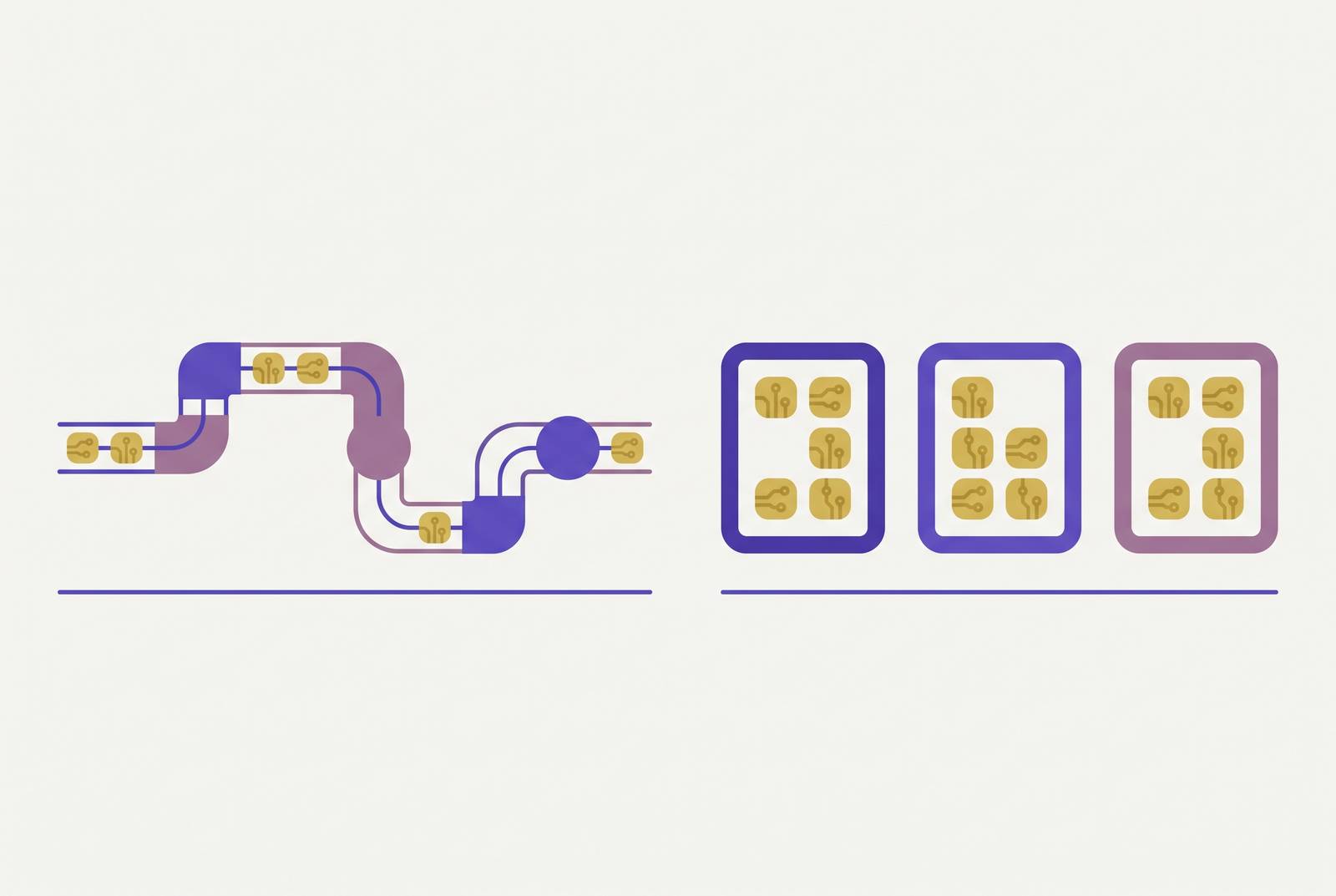
A CVE drops against a logging library on a Tuesday morning. A security team pulls up the SBOM generated at the last release, six months prior, and finds the version listed there. The document says the component is clean. What it does not say is whether the environment still matches what the document describes, and in most cases, it no longer does. A point-in-time SBOM is accurate for exactly one instant: the moment it was generated, after which the environment it documents keeps changing while the paper record stays frozen. The divergence is not random noise. Base image updates, patches applied outside the CI pipeline, runtime injections, and ordinary infrastructure changes all push the running system away from what the design and the build once described, and each of these is a routine part of operating software, not a failure of discipline. The most common path to that drift runs through unpinned transitive dependencies: a team pins the top-level library it chose deliberately, but the sub-dependencies that library pulls in keep moving, and a silent update downstream leaves the SBOM describing a system that no longer exists. The SBOM management buyer's guide states the consequence without hedging: "A point-in-time SBOM is a snapshot; it's stale the moment a new CVE is published against a component you shipped six months ago".
An SBOM goes stale without a new build because the environment it documents keeps changing independently of the build pipeline. Base image updates, patches applied outside CI, runtime injections, and unpinned transitive dependencies all push the running system away from what the document describes, and none of those changes trigger a new build. The hash gap follows directly from that drift: a package identifier only asserts what a component claims to be, while a hash captures what the component actually is, so an SBOM without current hashes cannot verify that what is deployed matches what is documented. Continuous generation fixes this by hooking SBOM production directly into source repositories and build pipelines, so every change to the environment produces a new document with build-time-observed hashes rather than post-build inferences, closing the window between what is running and what the record says.
What organizations do with SBOMs
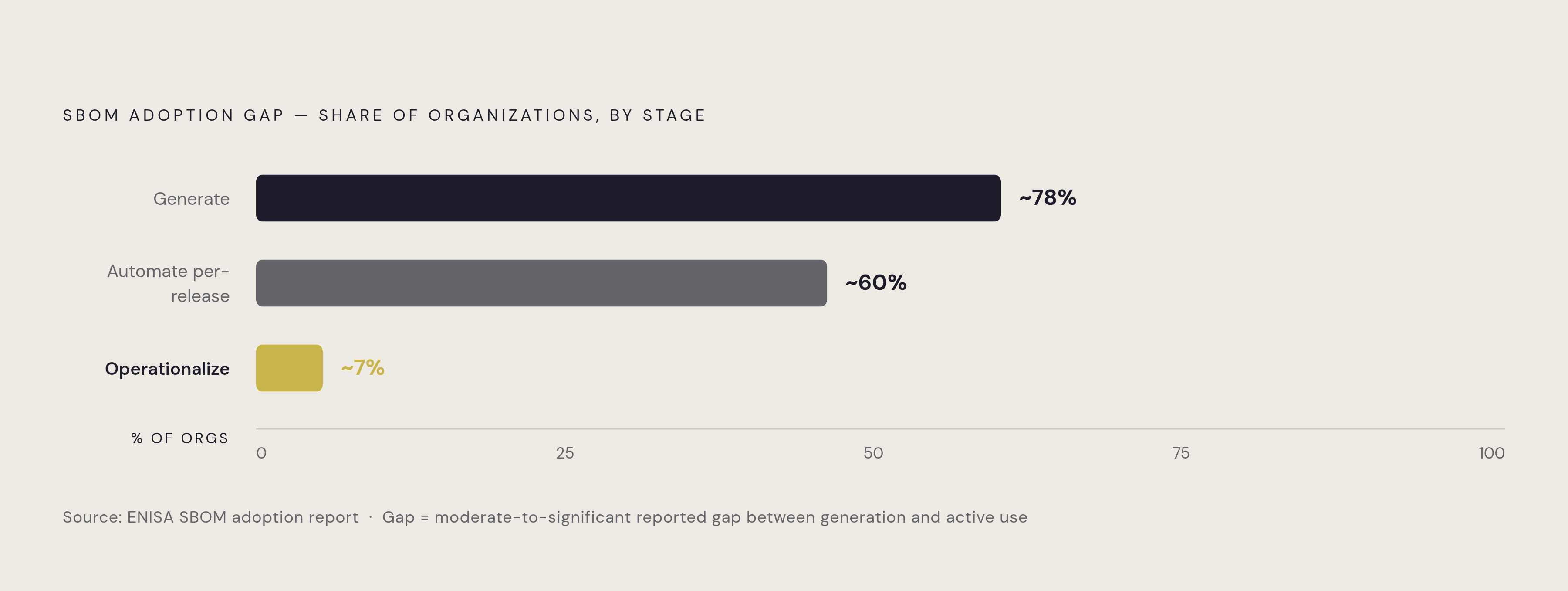
Most organizations that generate SBOMs file them as compliance artifacts at release time rather than operating them as active security controls, and that pattern persists even at organizations whose SBOM programs look mature on paper. ENISA's SBOM adoption report found that a majority now produce SBOMs and that roughly three-quarters have at least partially automated per-release generation, yet a majority also report a moderate-to-significant gap between generating SBOMs and actually using them, and only a small fraction have closed that gap entirely. ENISA's own conclusion names the pattern directly: SBOMs are used "mainly for compliance purposes" rather than as active security instruments, and a document sitting unread in an artifact registry functions as paperwork rather than as a control. The supply side of the ecosystem makes the gap wider rather than narrower. Most organizations never receive SBOMs from their commercial software suppliers, or receive them only rarely, and among the minority that do, the documents tend to cover direct dependencies while missing the transitive layer where most real-world vulnerabilities actually live. The pattern across both the demand side and the supply side points to the same structural limit: generating a document once per release cannot produce the kind of ongoing utilization that makes an SBOM worth having.
Why regulation now demands more than a filed document
Regulators have started writing the structural flaw directly into guidance, which turns the generate-once model into a compliance liability on top of the security liability it already carried. CISA's 2026 SBOM guidance replaces the 2021 baseline and expands its scope to cover open-source software, AI systems, and software-as-a-service, categories that were edge cases in 2021 and have since become the default shape of most software estates. The new hash requirement targets a specific weakness in how SBOMs have worked until now. A package identifier only tells a scanner what a component claims to be, while a hash captures what the component actually is, and requiring component hashes in every SBOM means the document can finally be used to verify that what is deployed matches what is documented, rather than simply what is asserted. The guidance also adds new minimum fields: component hash algorithm, component license, SBOM tool name, and SBOM generation context. These are additive for teams already working in CycloneDX or SPDX, but the generation context field quietly does something new by recording when and how an SBOM was produced, which makes cadence itself a visible, auditable attribute of the document rather than something left to assumption.
OMB M-26-05 moved agencies away from blanket attestation mandates and toward agency-led, risk-based approaches, a shift that makes solid minimum-element guidance more important rather than less, since agencies still need a verified baseline to build risk decisions on top of, and a stale snapshot cannot serve that function. AI and SaaS introduce a category of problem the build pipeline cannot solve by itself. A model or a dataset can change without any build ever running. SBOMs for AI components have to arrive contractually, through vendor terms, rather than being generated from source, and point-in-time, build-triggered generation has no mechanism that reaches that category at all. The hash requirement and the Cyber Resilience Act's demand for verifiable accuracy over time both presume that environments are stable enough to audit in the first place. Flox's approach of storing hash-pinned SBOMs and input-derived hashes at the environment level through FloxHub treats the declarative manifest, rather than a scanned artifact, as the unit of promotion, which ties component hashes cryptographically to what is actually running and aligns the practice with where the regulatory requirements are heading.
The difference between generating an SBOM and operating one
Continuous SBOM generation is not simply frequent SBOM generation run on a shorter timer. The distinction is whether the bill of materials for a given artifact gets produced at the moment that artifact is created, or gets reconciled afterward from a separate scan run on its own schedule. Automated generation that hooks directly into source repositories and build pipelines refreshes the inventory every time code changes, so the resulting document reflects what actually shipped rather than what a scanner could infer about it after the fact. What separates a document from a feedback loop is when the value gets created: not at generation, but at consumption. An SBOM's value is not created at the moment it is generated, but at the moment it is consumed: continuously correlated against authoritative vulnerability intelligence and mapped against actual deployment endpoints. Most software composition analysis platforms still tie SBOM generation to scan cadence, an arrangement that holds together only as long as release cadence and scan cadence stay synchronized. Once they drift apart, the SBOM window closes and the same point-in-time failure mode that this entire argument starts from reappears.
One format-level development extends the same logic further into the pipeline itself. The PBOM, or Pipeline Bill of Materials, originated by OX Security, is a continuously updated, signed ledger covering everything that produced an artifact, including pipeline definitions, runner identity, build arguments, artifact signatures, and full version lineage from first commit to production, treating the pipeline as an auditable artifact rather than an opaque process. Kubernetes workloads make the runtime half of the problem visible in a way static SBOMs cannot capture. Containers get replaced, modules load at runtime, and services connect and disconnect continuously, so an SBOM generated once at build time captures a single frame of a process that keeps moving, while a runtime-aware, continuous SBOM tracks dependencies as they evolve in production.
The honest answer when continuous SBOM generation breaks down
Raising the cadence of SBOM generation does not, by itself, produce a complete SBOM. Completeness remains difficult no matter how often the document gets regenerated, because the tooling that produces it carries coverage gaps that frequency alone cannot fix. A 2026 empirical study of SBOM tools found persistent adherence gaps between what the CycloneDX and SPDX standards specify and what the tools actually capture in practice, particularly around transitive dependencies and metadata fields like licenses, where inference performed at scan time is inherently lossier than observation performed at build time. A second objection comes from the security side rather than the tooling side. Even teams generating an SBOM on every build rarely close the loop to runtime reachability, and research from Endor Labs shows that only a small fraction of listed vulnerabilities are actually reachable in application code. A continuous SBOM without reachability filtering still floods a team with noise that is not exploitable.
Neither objection is an argument against continuous generation. Continuous generation is necessary but not sufficient: it eliminates the temporal gap that point-in-time snapshots cannot avoid, but closing the completeness gap requires observation at build time rather than inference after the fact, and closing the signal-to-noise gap requires layering runtime reachability data on top of the continuous inventory. Solving the generation cadence problem is what makes the reachability and completeness work possible in the first place, rather than a competing priority to it.
How continuous SBOMs change CVE response
A continuously maintained SBOM turns a disclosure from a fire drill into a query a team can run against a live system. Instead of asking whether a given library is in use somewhere and then grepping logs and re-scanning images to find out, a team queries the current inventory and gets an answer in seconds, with the affected deployment endpoints already identified. Getting a useful answer out of that query still requires cross-referencing every component against multiple sources: the NIST NVD, the OSV database, GitHub Security Advisories, and ecosystem-specific feeds for npm, PyPI, and Maven, since relying on NVD alone produces gaps where ecosystem-specific advisories publish earlier or with more actionable detail. VEX statements, which assert whether a vulnerable component is actually exploitable in context, only become operationally useful once there is a current, accurate SBOM to attach them to. A VEX statement claiming a component is unreachable cannot be trusted if the inventory behind it is months out of date.
A medical device manufacturer put this into practice by implementing per-release SBOMs that are signed and stored with immutable provenance, paired with policy gates that block a merge outright if banned licenses or high-risk components appear in it. That arrangement makes supply chain controls part of the development workflow itself rather than an audit performed after release. The same logic applies to prioritization. CVSS scores are fixed at the moment they are published, but exploitability keeps changing after that, and it takes CISA's Known Exploited Vulnerabilities catalog, which confirms active exploitation, together with EPSS, which adds temporal and contextual signal, to turn a static score into something a team can act on. Both of those signals are only useful when matched against an inventory that is actually current.
Why does continuous SBOM generation depend on the development environment being reproducible?
A continuously generated SBOM is only as trustworthy as the environment that produced it. If the build environment drifts between runs, the SBOM generated on Tuesday does not describe the same artifact as the one generated on Monday, even when both carry the same version label. The same drift problem occurs in AI agent workflows. When multiple agents run in parallel, each one inherits the quirks of its local environment, and differing tool installs across machines cause agents to produce different outputs from the same prompt, which makes continuous SBOM generation unreliable at the source if the environments feeding it are not themselves reproducible. Developer onboarding reveals this before anything else does: most software teams still cannot build and test their development environment quickly, and when a new engineer cannot reproduce the team's environment in minutes, the environments already in use across that team have likely diverged from one another without anyone noticing.
Continuous SBOM generation and reproducible environment management are not separate initiatives but the same one, with locking dependencies, pinning references, and making the environment itself a versioned, auditable artifact as prerequisites for an SBOM that can be trusted over time. Platforms built around declarative, hash-pinned environments can satisfy that constraint in ways that ad-hoc build workflows or loosely managed container setups tend to struggle with, because the manifest itself is what stays version-controlled and reproducible across development, CI, and production, which shifts the underlying question from keeping the SBOM synchronized to keeping the environment synchronized. Flox is one platform built on this model: because it builds on Nix, the dependency graph is fully observable at build time rather than inferred afterward, which closes the completeness gap that scan-time inference cannot reach and produces the kind of build-time SBOM data that the 2026 tooling studies identify as more reliable than post-build scanning. Flox also emits minimal, distroless OCI images when container workflows are required, so teams that need to attach SBOMs to container images do not have to rebuild their pipeline, since the manifest-first environment and the container output are the same verified artifact in different forms. Teams evaluating this space are generally weighing a few distinct approaches: ad-hoc build scripts bolted onto existing CI, container-first workflows where the SBOM gets generated against the final image, or environment-first platforms like Flox where the manifest itself is the auditable unit from the start. Each approach can produce an SBOM. Only an approach that keeps the environment itself pinned and reproducible can keep that SBOM honest once the environment it describes starts to change, which, as the CISA and CRA requirements already make clear, it always eventually will.