OSS Dependency Risk Assessment for Regulated Industries
Regulated industries face four compounding open source risks that point-in-time scans cannot catch.
Open source dependency risk in regulated industries is no longer a single problem that a scanner can catch in one pass. It is four distinct risks, compounding under regulatory deadlines that are already active, and the ad-hoc scanning practices most organizations still rely on were never built to handle any of that interaction.
Compounding OSS risk in regulated industries
Picture a bank's engineering team running its usual quarterly dependency scan. The scan returns clean, or clean enough. Three weeks later, a developer pastes a utility function from a vendor's documentation page directly into a service file, no package manager involved, no manifest entry, nothing for the scanner to find on its next pass. That single action sits at the center of why regulated industries face something worse than "more risk" than other sectors: they face several risks that feed each other, and a point-in-time scan only ever sees one slice of one of them at a time.
Three dynamics are running at once. Vulnerability counts are climbing fast: Black Duck's 2026 Open Source Security and Risk Analysis (OSSRA) report found mean open source vulnerabilities per codebase rose 107% year-over-year, driven in large part by AI-assisted development accelerating how much code gets written and shipped. At the same time, a meaningful share of components now enter codebases outside any package manager, making them invisible to tools that only read manifests. Maintenance debt is the slow accumulation of outdated, abandoned components, and it is building up faster than regulated-industry change-control processes can clear it.
That invisibility problem is not an edge case. The 2026 OSSRA report found that open source components regularly enter codebases through copy-pasted snippets, direct vendor inclusions, or AI code generation, all outside standard package management, all undetectable to tools built to parse manifests and lock files. And the maintenance debt problem is not distributed evenly across industries: Black Duck's 2026 OSSRA found Financial Services and Retail/eCommerce applications among the highest vulnerability concentrations of any sector measured, precisely because the regulatory change-control requirements meant to protect these industries also slow down how fast they can patch. So the rules meant to reduce risk end up stretching out the time known vulnerabilities sit unaddressed in production.
The four distinct risk categories that make up the OSS exposure surface in regulated environments
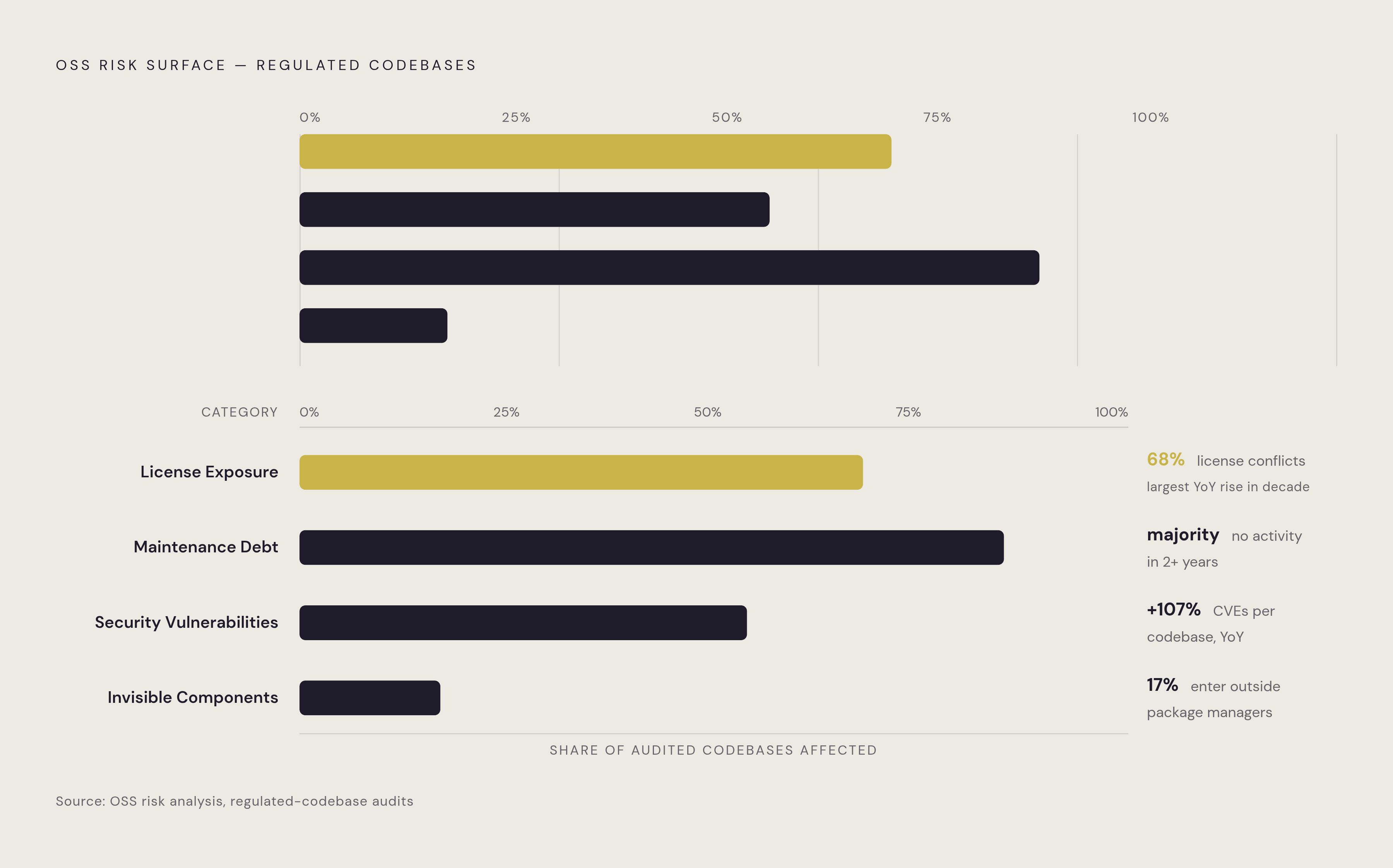
OSS risk in a regulated codebase breaks down into four separate categories. Each has its own cause, its own way of getting detected (or not), and its own path to fixing it. Treating all four as one undifferentiated "open source risk" is a large part of why ad-hoc scanning keeps coming up short: a single scan, run one way, can address at most one of these categories at a time.
Security vulnerabilities make up the most familiar category. The 2026 OSSRA found that the mean number of open source vulnerabilities per codebase has more than doubled. Most audited codebases now have at least one vulnerability, and a substantial share have critical-risk issues that allow remote code execution. Supply chain attacks compound this: most attack volume today comes not from someone hijacking a legitimate, trusted package, but from malicious packages built from the start to deceive, through typosquatting and social engineering aimed at developers who are moving fast and not checking closely. Sonatype's data, cited in Vulert's 2026 report, shows that known malicious packages across major registries have climbed into the millions cumulatively, with a steep annual increase in 2025 over the year before.
Invisible components make up the second category, and detecting them requires a different method entirely than scanning for CVEs. A significant share of components enter regulated codebases with no package-manager record at all: pasted snippets, code bundled in from a vendor, AI-suggested libraries installed without ever touching a lock file. None of this is visible to a manifest-only software composition analysis tool, because manifest-only tools are built to read exactly the kind of record these components never create.
Maintenance debt is the third category, and it behaves less like a vulnerability and more like slow decay. The 2026 OSSRA documents that the overwhelming majority of codebases contain components with no development activity in the past two years, and components that are four or more years out of date, with only a small fraction of components running the latest available version. When a vulnerability eventually surfaces in one of these unmaintained projects, the fix options, forking the project, refactoring around it, or formally accepting the risk, all cost time and engineering effort that regulated organizations are poorly positioned to spend quickly, given how their change-control processes work.
License exposure is the fourth category, and it is growing fastest. The 2026 OSSRA identifies the largest year-over-year increase in licensing conflicts in the decade the report has been published, and it found that 68% of audited codebases now contain license conflicts. A new driver behind this is what amounts to license laundering: AI coding assistants generating code derived from copyleft sources without carrying forward any license metadata, leaving the resulting code looking clean when it carries real obligations. Most organizations are not yet evaluating AI-generated code for intellectual property or licensing risk. In a regulated industry, a license conflict discovered during M&A due diligence, a product launch, or a regulatory audit cannot be patched quietly the way a code vulnerability can. It has to be disclosed, often renegotiated, sometimes litigated.
The regulatory forcing function arriving faster than organizations are moving
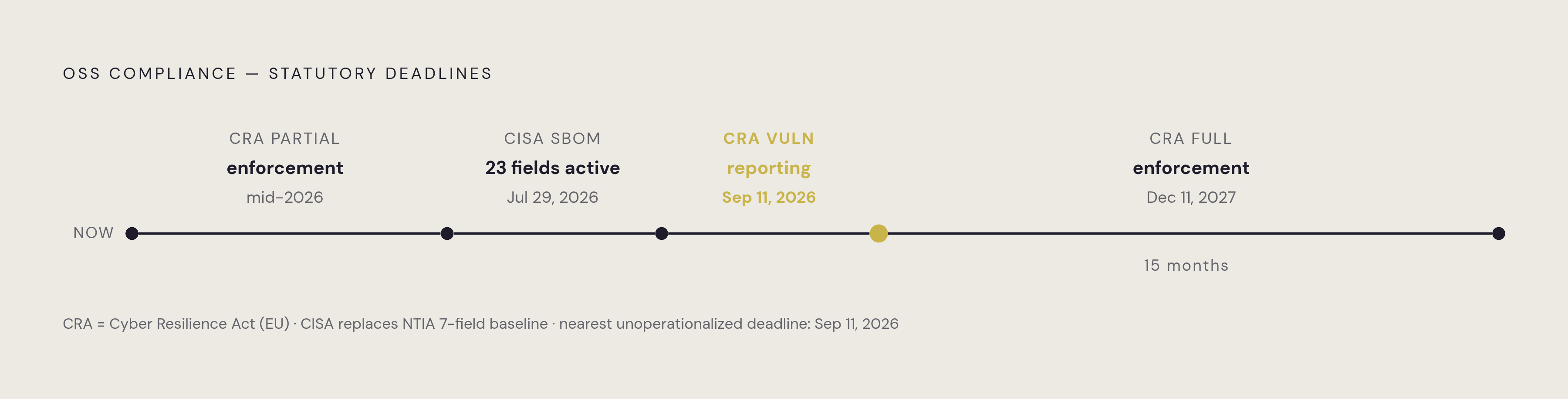
The technical risk picture above would be reason enough to act. But regulated organizations are also now up against statutory deadlines that make a structured OSS assessment a legal requirement rather than a best practice.
The EU's Cyber Resilience Act (CRA) is the clearest example. The 2026 OSSRA notes the CRA began partial enforcement in 2026, with vulnerability reporting obligations applying from September 11, 2026, and full enforcement arriving December 11, 2027. The law requires manufacturers of connected products to maintain software bills of materials (SBOMs), manage cybersecurity risk across the full product lifecycle, and report actively exploited vulnerabilities within 24 hours. The fines for noncompliance are substantial, and the format requirements are specific: the CRA calls for SBOMs in a commonly used, machine-readable format, and Germany's BSI guideline already spells out what that means in practice, expecting CycloneDX 1.6 or higher, or SPDX 3.0.1 or higher.
Financial services faces its own version of this through DORA. Article 9 requires documented, comprehensive policies covering patches and updates, and Article 25 goes further, stating that digital operational resilience testing may include vulnerability assessments and scans, open source analyses, and source code reviews where feasible, among other testing types. That is a regulation directly calling for the kind of systematic OSS assessment this piece describes.
In the US, the standard has shifted underneath organizations that thought they had already complied. The CISA 2026 minimum elements replaced the NTIA's 2021 seven-field baseline on July 29, 2026, and now define 23 required elements across three groups: SBOM Metadata, Component Data, and Practices and Processes. New fields include Component Hash Value, Component Hash Algorithm, Component License, and SBOM Author Signature. Any organization that built its SBOM tooling to the old 2021 baseline now has a compliance gap it may not know about yet.
None of these frameworks stands alone. SBOM-related compliance obligations now run through NIST 800-53, NIST 800-171, NIS2, the UK's Software Security Code of Practice, FDA medical device requirements, and PCI DSS 4.0, so few regulated organizations get to treat any single framework as their only obligation. Vulert's 2026 industry report finds a gap in this adoption: SBOM generation is growing, but a stale SBOM creates false confidence rather than real assurance. Most organizations today sit in the space between generating an SBOM once and actually operationalizing it as a living record. The deadlines above are fixed and the penalties are specific, and that combination turns a structured OSS risk framework from a nice capability into a business requirement.
One-time scanning as a risk assessment method
A single scan, run once, checks one risk category at one moment in time. The four risk categories described above don't sit still, and the regulatory deadlines above don't pause for an annual audit cycle. Put those two facts together and episodic scanning stops being a viable risk assessment method, structurally, not just as a matter of execution quality.
The common failure mode looks like this: developers pull in packages freely during normal development, with no controls at the point of entry. Later, a bolted-on security scanner runs, flags hundreds of vulnerabilities at once, and hands engineering a remediation backlog it has to work through under pressure. This is reactive by design, it slows engineering velocity every time it runs, and it only ever catches declared, manifest-visible components, leaving the other three risk categories untouched.
A real framework needs five structural properties, and no single scan can give you all of them.
The first is continuous inventory instead of a point-in-time snapshot. A stale SBOM does not satisfy CRA or DORA obligations; it documents a past state of the codebase that may already be wrong by the time anyone reads it.
The second is detection that goes beyond the manifest. A framework has to catch components that entered the codebase outside package managers altogether, including AI-suggested libraries, pasted code snippets, and vendor-bundled packages, because manifest-only scanning misses a real share of the actual component inventory by construction, not by oversight.
The third is full transitive dependency traversal. Black Duck's 2026 OSSRA found that 64% of OSS components in a typical codebase are transitive, so a framework that only documents direct, declared dependencies leaves most of the actual attack surface unexamined.
The fourth is multi-dimensional risk scoring instead of a simple CVE lookup. Every component needs evaluation across all four risk dimensions at once: active vulnerabilities, maintenance status, license conflict potential, and provenance, meaning how the component entered the codebase and whether it's pinned to a known version or hash. A component with zero current CVEs but no maintainer activity in two years carries a very different risk profile than one under active, recent maintenance, and that distinction has to inform real change-control decisions in a regulated environment, not get flattened into a single pass/fail score.
The fifth is remediation prioritization rather than simple enumeration. If a list has a thousand findings with no ranking, it tells an engineering team almost nothing useful. So a usable framework ranks findings by exploitability and regulatory materiality, and the issues that carry real legal and security weight rise to the top instead of getting lost in volume.
Building the assessment framework: the four-phase workflow for regulated environments
A structured OSS risk assessment built for regulated environments runs across four sequential phases: discover, analyze, govern, and monitor continuously. Each phase closes one or more of the gaps that ad-hoc scanning leaves open.
Discovery comes first, and its job is building a complete, living inventory of every component in the codebase. That means multi-method detection: parsing manifests and lock files as a baseline, but also scanning compiled artifacts and binaries directly for embedded open source that never showed up in any manifest. It means tracing transitive dependencies to the full depth of the dependency graph, not stopping at direct, declared dependencies. And it means flagging everything that entered outside a package manager. Black Duck's 2026 OSSRA found that 17% of open source components enter codebases outside standard package managers, so an AI-suggested library with no lock-file entry is a gap in what you even know you're running, layered on top of a known inventory. The output of this phase should be an SBOM in a standard, machine-readable format, either CycloneDX or SPDX, meeting the CISA 2026 23-element minimum, generated automatically at build time and attached to the build artifact itself. Harness's dependency risk guide describes the value of this step: cataloging every piece of software in a product lets a team quickly identify and patch affected components whenever a new vulnerability appears.
Analysis comes second, and its job is to score every component across all four risk dimensions. On security, each component should be checked against multiple vulnerability databases instead of the National Vulnerability Database alone. The NVD's own backlog episode, during which the large majority of new vulnerabilities went unanalyzed for a stretch, showed what can go wrong when an organization leans on a single source for vulnerability intelligence. On maintenance, components with no upstream commits in two or more years, or that sit a defined number of versions behind current, need flagging, and in a regulated environment, choosing to keep an unmaintained component in production should require a documented, formal risk-acceptance decision rather than silent tolerance. On license, every component needs its license classified, with any copyleft obligations that conflict with the product's distribution model identified, and any component with no license metadata at all flagged as a distinct compliance risk under the CRA. On provenance, the analysis should record how each component entered the codebase, whether it's pinned to a specific version or hash, and whether its supply chain integrity can actually be verified. The output here is a prioritized finding list, ranked by exploitability and regulatory materiality, instead of a raw count of CVEs sorted by severity score alone.
Governance comes third, and its job is to embed controls directly into the development workflow, before code ever reaches production, rather than reviewing it after the fact. Policy-as-code is the mechanism: risk thresholds get encoded as automated gates inside the CI/CD pipeline itself. A pipeline might block any component carrying a critical CVE with no available fix, or flag any copyleft-licensed component introduced into a proprietary product, and it does this automatically, at the point code is built, instead of as a manual review step after release.
The fourth phase, continuous monitoring, carries the framework forward once it's in place: the inventory, analysis, and governance gates all need to keep running against every new build, every new dependency, and every newly disclosed vulnerability, so the SBOM stays a current record rather than the stale snapshot that Vulert's 2026 report warns creates false confidence. A regulated organization that runs all four phases on a continuous basis is positioned to meet CRA, DORA, and CISA obligations as they stand today, and to keep meeting them as the component inventory, the vulnerability landscape, and the regulatory baseline all keep moving.