Multi-Architecture Toolchain Supplier Risk Considerations
Compromised build systems now poison entire enterprises through concentrated supplier dependencies.
The production perimeter used to be the place attackers wanted to stand. It no longer is. A single compromise placed upstream, inside a build system or a widely used library, now reaches every downstream consumer at once, and 2026 supplied a clean illustration when a compromised maintainer account poisoned a library with 100 million weekly downloads.
Why the developer toolchain became the highest-value attack surface
Compromising a build system or a dependency used across an industry gives an attacker, in one move, the kind of access that would otherwise take thousands of separate break-ins to assemble, because the trust a known vendor or a legitimate registry carries becomes something the attacker now owns too. That is the logic the Cloud Security Alliance laid out in its May 2026 whitepaper, and it explains why so much offensive attention has moved off the network edge and into the tools developers use to write, build, and ship code.
SolarWinds SUNBURST remains the clearest large-scale proof of this logic, even years on. Disclosed in December 2020, the operation involved adversaries compromising SolarWinds' own build system and inserting a backdoor into a signed Orion update that then reached tens of thousands of organizations. The lesson held: the assembly chain, not the perimeter, was where the leverage lived.
XZ Utils, uncovered in 2024, showed the same principle playing out in open source, driven by patience rather than force. An actor spent more than two years contributing to the project, earned co-maintainer status, and only then introduced obfuscated malicious code into the build system. No firewall stops that kind of intrusion, because it doesn't look like an intrusion until the very end.
None of this should surprise anyone who understands how the toolchain was built. It was designed to make developers fast, not to resist adversaries. Local tools run with broad execution authority, build systems are allowed to pull and execute arbitrary code from the internet as a matter of routine, and credentials often sit in environment variables right next to the source they're meant to protect. That design was reasonable when the toolchain was assumed to be a closed, trusted space, but it stops being reasonable the moment concentration enters the picture.
Supplier concentration and organization-wide compromise
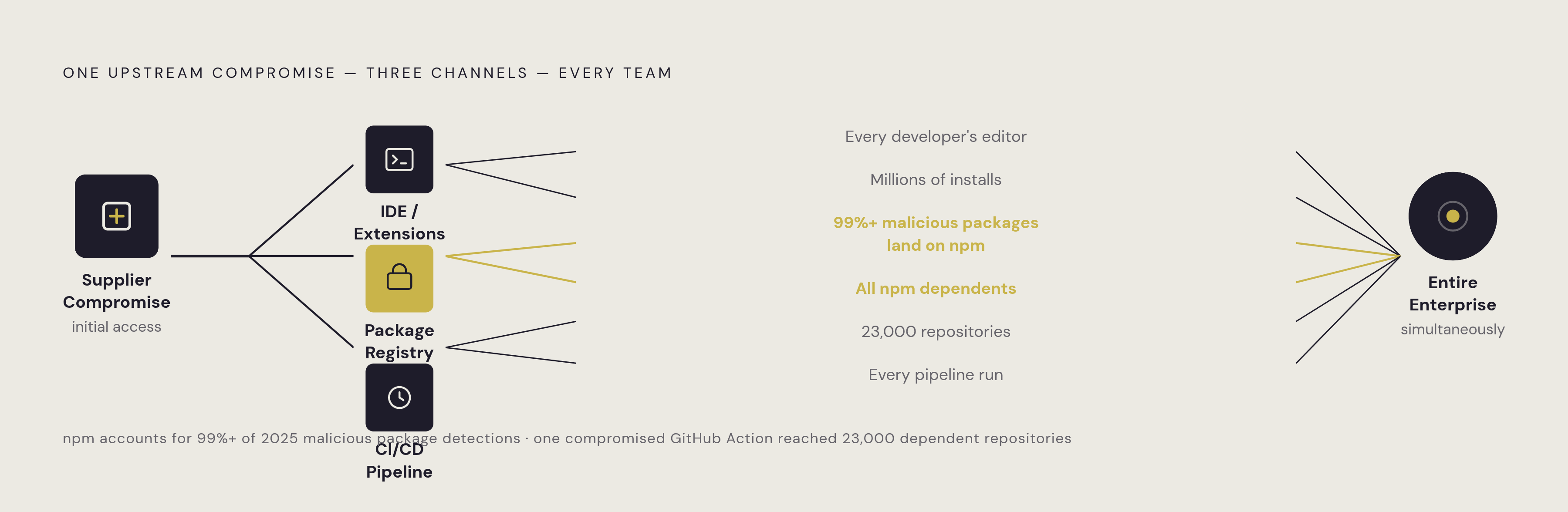
A single compromise only becomes an enterprise-wide event when the toolchain around it is concentrated. When every team draws from one registry, runs its automation on one CI/CD runner ecosystem, and installs extensions from one IDE marketplace, a failure in any single node spreads to every team, every architecture, and every pipeline at the same time. Blast radius is a function of how concentrated the supply is, not how sophisticated the initial intrusion was.
The CSA whitepaper names three channels through which this concentration operates: IDE and extension compromise, package registry poisoning, and CI/CD pipeline subversion, and its central claim is that these three vectors interact, so that one initial access event can ripple across an entire enterprise software estate. Each channel has already produced its own case study.
On the registry side, Sonatype's 2026 State of the Software Supply Chain documented hundreds of thousands of new malicious packages identified across npm, PyPI, Maven Central, NuGet, and Hugging Face in 2025, with more than 99% of that malware landing on npm alone. That single number says most of what needs saying about why npm concentration amplifies risk structurally rather than incidentally.
On the CI/CD side, a February 2026 campaign run by an actor identified as "hackerbot-claw" automated the scanning and exploitation of public repositories for misconfigurations, including the dangerous pull_request_target trigger combined with excessive token permissions, using five distinct exploitation techniques that cascaded into five separate tool compromises within days. That speed was possible because so many teams shared the same runner ecosystem and carried the same misconfiguration.
On the IDE side, three separate 2026 incidents trace back to the same distribution channel. A malicious version of the AsyncAPI VS Code extension exfiltrated credentials undetected for roughly a month. Malicious VS Code AI extensions with millions of combined installs were found harvesting developer source code in January. The Nx Console extension was compromised in a release targeting thousands of developers in May. All three exploited the single-supplier nature of the VS Code marketplace.
The transmission mechanism underneath these incidents is what turns them into enterprise-wide events. Datadog's State of DevSecOps 2026, cited in the CSA paper, found that most organizations leave GitHub Actions marketplace dependencies completely unpinned, and roughly half install new library versions shortly after release. Speed and the absence of version pinning work together to carry a single compromised node into every corner of an organization that depends on it.
Why multi-architecture environments make concentration risk worse, not better
Running on more than one architecture does nothing to reduce this exposure, and it tends to compound it. ARM/x86 heterogeneity is now the default operating condition for most infrastructure teams: ARM64 instances carry real cost and energy advantages, and moving Kubernetes workloads onto ARM means building multi-architecture images and managing node affinity, so a team that once maintained one image pipeline now maintains two or more, each with its own dependency surface. More pipelines mean more places a compromised dependency can get in, not fewer.
The GKE Config Connector case from June 2026 shows what happens when a supplier builds for one architecture and assumes the rest will follow. KCC had previously released AMD64 images only, so scheduling Config Connector pods on ARM64 nodes in a mixed node pool either failed outright or required restrictive admission webhooks to pin workloads back to AMD64 nodes, a problem documented directly in the GKE Config Connector repository. Nothing about this was a security incident. It was an operational failure born from a supplier's architectural blind spot, and it propagated straight into any fleet running a mixed node pool.
Multi-architecture environments also widen the surface without changing where trust is placed. Each target architecture typically pulls from the same upstream registries and package feeds, so a single compromised package reaches every architecture at once. The attack surface grows additively with each new architecture, but the number of places an organization actually places its trust does not grow.
The TeamPCP campaign, active between February and March 2026, demonstrates how deep this second-order trust problem runs. Unit 42 documented that the campaign compromised Trivy, KICS, LiteLLM, and the Telnyx Python SDK, security scanning infrastructure and AI tooling that most enterprises treat as trusted by default. Teams running these tools across several architectures inherited the compromise everywhere those tools ran, not on a single machine in a single pipeline.
MCP servers add a newer category of risk that is architecture-agnostic by design. eSecurity Planet reporting found that most organizations have no consistent governance over MCP servers, even as community-built servers now exist for GitHub, Slack, PostgreSQL, Stripe, Figma, Docker, Kubernetes, and more than 200 other tools. These servers run on whatever architecture the agent calling them happens to run on. The governance gap travels with the agent rather than staying fixed to one platform. More architectures bring the same supplier trust model and the same absence of scrutiny, just spread across a wider footprint.
Open source malware industrialization and shared package feeds
The threat sitting on public package feeds has stopped behaving like a string of isolated incidents and started behaving like an industry. Sonatype's 2026 report draws the line clearly: where the 2024 XZ Utils incident stood out because one compromised maintainer could threaten global infrastructure, 2025 brought five-stage payload chains from the Lazarus Group, the first self-replicating npm malware in Shai-Hulud and its successor Sha1-Hulud, and campaigns such as IndonesianFoods that generated more than 150,000 malicious packages in a matter of days. Scale and automation define this shift as much as sophistication does.
Sonatype organizes this activity into patterns rather than individual stories, and the patterns are worth taking seriously on their own terms. One is repository abuse, actors treating public registries as platforms, automating publication, and iterating fast to maximize reach. The other is toolchain masquerading, where malicious packages increasingly impersonate framework add-ons, build plugins, linters, scaffolding utilities, and migration helpers, built specifically to look like the routine dependencies a developer installs without a second thought.
The prize behind both patterns is consistent. Secrets exfiltration and host information exfiltration are smaller by volume than other payload types, but they carry outsized leverage, because the packages run inside developer machines and CI/CD environments where tokens, API keys, and CI credentials sit ready for reuse, present on every architecture the pipeline happens to target.
Staged delivery is what makes point-in-time scanning insufficient against this kind of threat. Droppers, backdoors, and obfuscated code let a package gain initial access while looking entirely benign, then deliver its actual payload later. A dependency that passes a scan at ingestion can turn malicious well after it has already been installed. The common objection, that scanning on ingest already catches this, runs straight into that pattern: a package can pass its install-time scan clean and still receive a malicious payload through a command-and-control channel afterward, exactly the transitive dependency behavior the CSA whitepaper describes as propagating compromise silently across organizational boundaries.
Unpinned, implicit dependencies as the common root cause
IDE extensions, package registries, and CI/CD pipelines look like three different problems with three different fixes. They share one root condition. Dependencies that are implicit rather than explicitly declared, and unpinned rather than locked to a specific version, mean the environment an organization runs today is not guaranteed to be the environment it runs tomorrow, absent some deliberate action to keep it fixed.
That condition is also the root cause of environment drift, the everyday reliability problem that has nothing to do with attackers. The ActiveState guide to reproducible environments names unpinned transitive dependencies and unmanaged system libraries as the primary cause of broken collaboration between teams. The CSA whitepaper names the same unpinned, implicit dependencies as the attack vector that enables supply chain compromise. Reliability and security turn out to be two different lenses pointed at the same structural fact.
The data on CI/CD bears this out directly. Datadog's State of DevSecOps 2026 found that most organizations leave GitHub Actions marketplace dependencies completely unpinned, and roughly half install new library versions shortly after release. Speed pressure, the ordinary push to ship faster, is the organizational mechanism that keeps dependencies unpinned even among teams that understand the risk perfectly well.
The hackerbot-claw campaign shows what that pressure costs in practice. The pull_request_target misconfiguration carried by Aqua's Trivy repository had been documented as dangerous well before it was exploited, and the scale such a vulnerability class can reach is not hypothetical: 23,000 repositories depended on the compromised tj-actions/changed-files action in March 2025. The failure here was not ignorance of the risk. Pinning and auditing every action across a large pipeline estate takes deliberate process, and good intentions alone don't supply that process.
Multi-architecture environments turn this into a multiplication problem. A team running separate pipelines for AMD64 and ARM64 carries two sets of unpinned dependencies, two sets of base image pulls, and two sets of runner configurations, each one a separate point where an updated but compromised dependency can get in. Adding architectures without adding pinning discipline doesn't diversify risk. It duplicates it.
SBOM generation versus cross-architecture provenance tracking
The instinct to answer all of this with a software bill of materials is reasonable, and it's also only a partial answer. Generating an SBOM is a solved problem at this point. The harder operational work is correlating SBOMs across multi-tier supply chains, validating them against a live dependency graph, and producing attestations that still mean something when the same environment runs on multiple architectures with architecture-specific dependency resolutions.
Practitioners at the S3C2 Government Supply Chain Summit converged on the same view: producing a trustworthy SBOM takes real effort, but the harder work is everything that comes after generation, ingesting SBOMs from upstream suppliers, validating them against an organization's own dependency graph, correlating them across multiple tiers of suppliers, and exporting them in whatever format a regulator or customer happens to require. An SBOM that lists what was true on AMD64 at build time says nothing reliable about what actually resolved on ARM64, and an organization running both architectures needs provenance that travels with the environment definition itself, not a snapshot that only describes one branch of its infrastructure. Treating environment definitions as pinned, auditable artifacts carrying their own provenance across every architecture they target is what closes that gap. Nothing less reaches it.
Sources
- Software Supply Chain Risks
- AI Software Supply Chain Threats Escalate in 2026
- 🔴 Supply Chain Attacks Are Breaking the Internet in 2026 — Every Major Hack Explained - DEV Community
- The Developer Toolchain as Enterprise Attack Surface
- The Open-Source Trust Crisis in 2026
- Building Reproducible Software Environments: A Practical Guide