Corrected SBOM Signing and Distribution After Remediation
Corrected SBOMs require a full workflow rerun, not edits to old files.
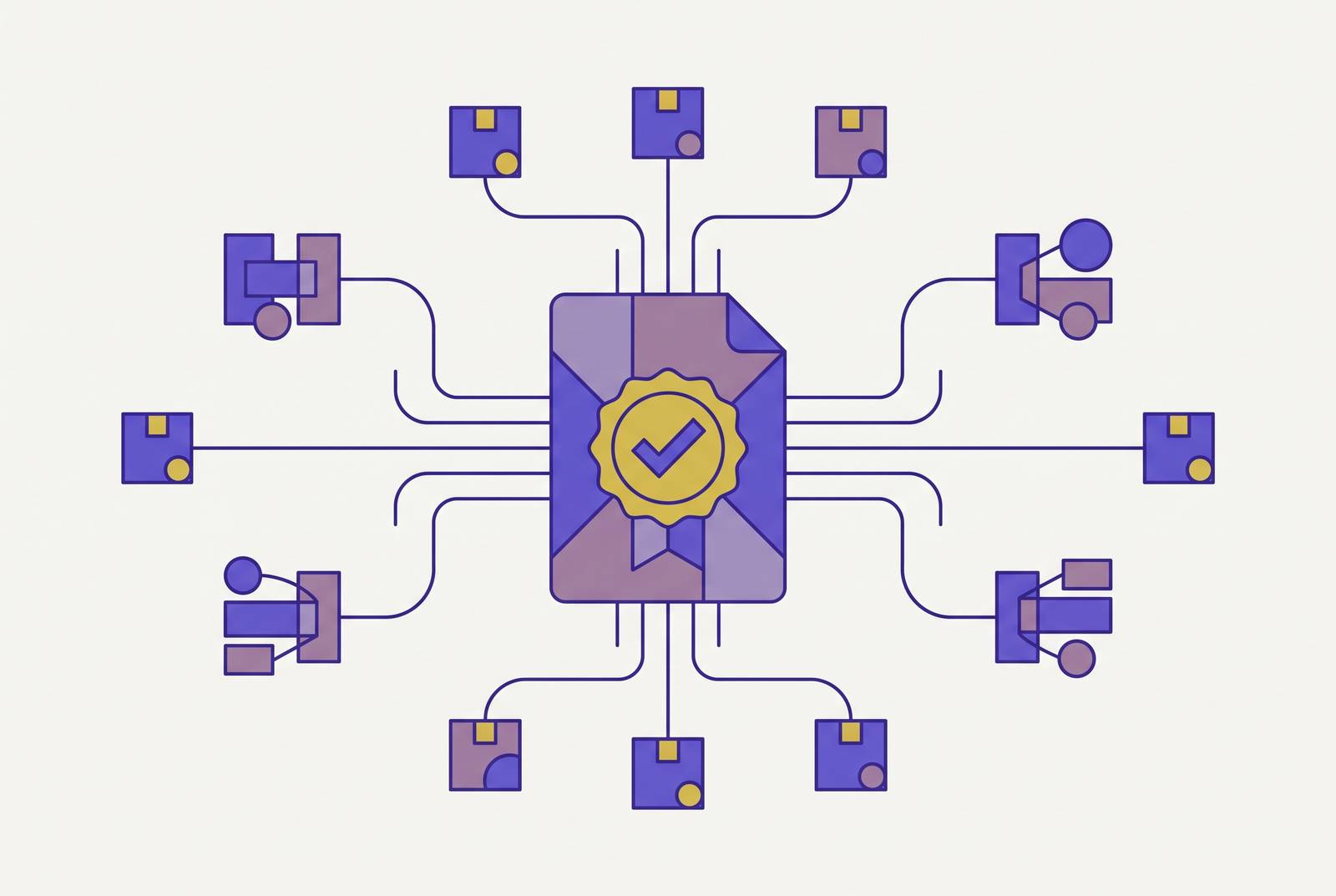
A corrected SBOM is the output of a full workflow rerun: rebuild, regenerate, re-scan, re-sign, and redistribute, with each stage feeding the next. Teams that treat post-fix SBOM correction as a quick edit to an old document break the chain of custody the SBOM was supposed to prove. Regulators and customers now expect the corrected document to hold up under audit, not just look tidy in a repository, and that distinction matters more in 2026 than it did even two years ago.
Most engineering teams can already generate an SBOM. Far fewer can produce a clean, signed, auditable record after a vulnerability gets fixed, and that gap is where the real work lives. Generating a bill of materials once, at release time, is a compliance exercise. Keeping it accurate as code changes, dependencies get patched, and vulnerabilities get triaged is a living provenance problem, and it behaves nothing like a one-time checkbox. Yeeth Security's analysis found that the hard part in 2026 isn't generation anymore, it's wiring generation, vulnerability enrichment, VEX triage, remediation, and attestation into one repeatable workflow that satisfies customers, auditors, and regulators at the same time. A corrected SBOM, under that framing, means re-running the entire chain and replacing every signed artifact tied to it, not editing a JSON file by hand.
The regulatory backdrop makes ad hoc housekeeping an unaffordable habit. The EU Cyber Resilience Act's first reporting obligations took effect on September 11, 2026, with machine-readable SBOMs mandated for products with digital elements starting December 11, 2027. CISA, alongside the NSA, the FBI, and international partners, published updated 2026 Minimum Elements for an SBOM on July 29, 2026, replacing the 2021 NTIA guidance with requirements that reflect current tooling. And in the US, OMB's M-26-05 memo, issued in January 2026, rescinded M-22-18 and its companion M-23-16, scrapping the government-wide attestation model and telling each agency to set its own risk-based rules instead. None of these bodies are asking for a document. They're asking for a process that can be rerun and checked, and plenty of teams are going to discover their "SBOM program" was one PDF export away from not existing.
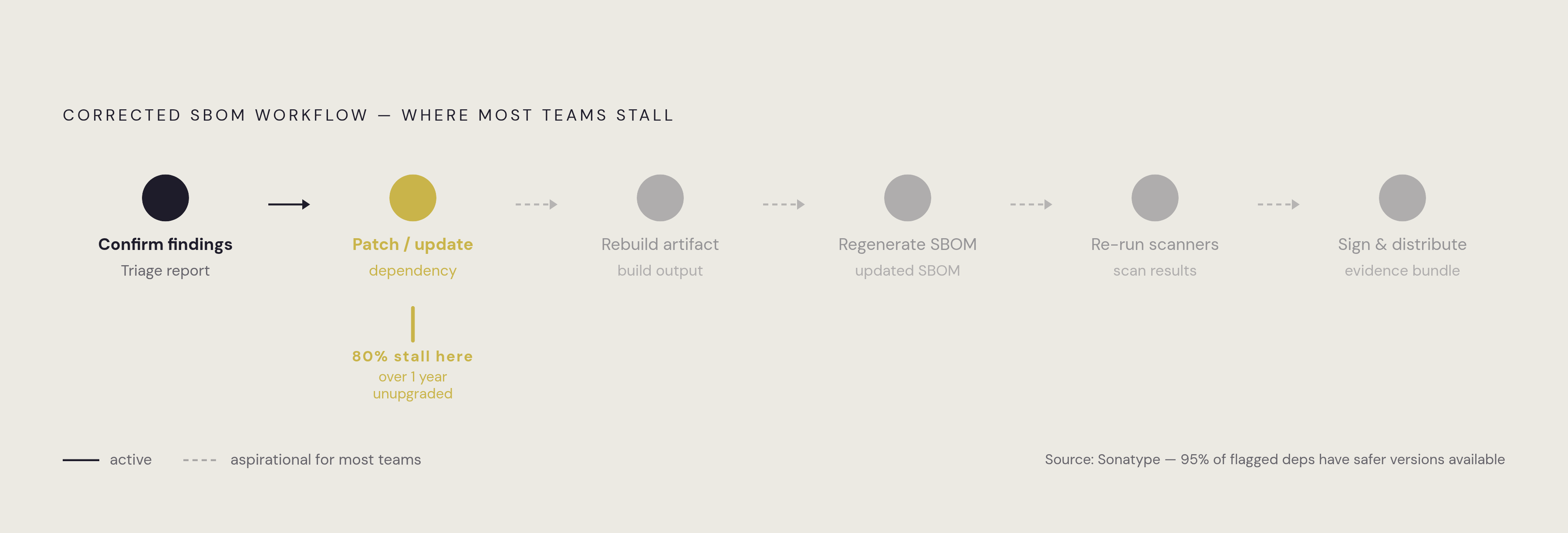
The loop, as described across current practice, runs in six stages: confirm the affected findings, patch or update the dependency, rebuild the artifact, regenerate the SBOM, re-run the scanners, then sign and distribute the resulting evidence bundle. Each stage hands off an artifact that the next stage checks against reality. Skipping a stage, or reordering it, snaps the audit trail somewhere downstream, usually during an incident review, when nobody has time to reconstruct what actually happened.
Most teams never even get this far, and the patch stage is where the loop actually breaks. Research from Sonatype, cited by OX Security, found that 80% of dependencies go unupgraded for over a year, even though safer versions exist for 95% of the vulnerable ones flagged. That's a stall well before regeneration or signing ever comes into play, and it means the six-stage loop most teams are actually running has only two working stages: confirm, then stall.
"Fixed" is a status that belongs in the VEX record and the re-signed SBOM, nowhere else. VEX documents carry four statuses: Not Affected, Affected, Fixed, and Under Investigation. A VEX record still pointing at the old SBOM is not evidence that anything got remediated. It's a stale claim attached to a stale artifact, and treating it as proof of anything is the mistake that appears in an audit six months later, usually at the worst possible time.
Some of this loop can run without a human in it, and should. If the fix is a straightforward dependency bump with a known safe version, For a straightforward dependency bump with a known safe version, the whole cycle ought to automate inside CI, no human sign-off needed for a patch version bump that passes tests. If the fix needs judgment, someone with the right context has to own the decision, and the routing has to happen deliberately rather than by whoever happens to see the alert first. Cadence matters too: the TechBytes 2026 cheat sheet recommends reviewing VEX statuses quarterly at a minimum. Anything staler than that becomes a compliance liability rather than a record of anything real.
Choosing and locking a format before regeneration begins
Two formats anchor most SBOM programs as of 2026: CycloneDX 1.7, released in October 2025, and SPDX 3.0.1. Both describe components, dependencies, licenses, and provenance in a form machines can parse, and increasingly, customer contracts expect JSON output rather than a PDF someone exported for a checklist.
Pick CycloneDX unless a specific policy reason says otherwise. Current guidance frames it as the format with broader tooling interoperability, and a September 2026 DevOps industry article calls it the de facto standard for containerized applications. It also covers a wider set of specialized types: HBOM, ML-BOM, CBOM, SaaSBOM, MBOM, OBOM, VDR, VEX, and CDXA. SPDX earns its place in policy-heavy environments and cross-organization exchange scenarios where a legal or procurement team already has SPDX baked into contract language. For most engineering teams shipping containers, this is the exception rather than the default. VEX itself layers on top of either format; it isn't a replacement for one.
Format choice comes with sharp edges that bite before anyone notices. Trivy's own documentation notes that CycloneDX XML isn't supported as scanner input, a detail that matters enormously if a pipeline assumes any valid CycloneDX file will work everywhere. Format and toolchain need validating together, not picked separately and hoped into compatibility, because that mismatch becomes visible in an audit instead of in testing, and by then it's a finding instead of a fix.
None of this changes once remediation starts. The corrected SBOM has to use the same format as the original, applied the same way, or downstream consumers face a reconciliation headache nobody signed up for. CISA's 2026 Minimum Elements guidance also adds new required fields: component hash, license, tool name, and generation context. The corrected SBOM has to satisfy those requirements outright, matching what the document actually contains to what's required. And for tracing a component across releases without ambiguity, canonical identifiers, PURLs or UUIDs, are what let an updated dependency get followed cleanly from one version to the next.
Regenerating the SBOM from the corrected build, not from the old file
A corrected SBOM comes from the rebuilt artifact. Full stop. It does not come from patching the old file in place, because the inventory has to match the binary that actually ships, not the binary the team meant to ship. That's the whole point of a bill of materials: it describes what's really there, not what the changelog claims is there.
Generation belongs at build time, automatically, as a first-class output of the pipeline rather than a manual export somebody remembers to run after the fact. TechBytes' 2026 cheat sheet treats a missing SBOM as grounds for a failed quality gate, and that's the right call. For containerized workloads, regeneration has to cover base image layers alongside application dependencies. A fix that touches the base image needs a full container rebuild and rescan; a patch applied to the application layer while the base image sits untouched isn't enough, and treating it as enough is how a fixed CVE reappears three releases later.
Rebuilds drift more than most engineers expect, and that drift is the whole reason "just rebuild it" isn't a trivial instruction. A study of Docker builds found only 6.4% of rebuilt images matched the original set of installed package versions exactly. That's a strikingly low number, and it means identical rebuilds often aren't identical. The corrected SBOM has to come from the actual rebuilt artifact rather than an assumption that a rebuild reproduces the original bit for bit.
Two production-grade generators sit at the center of the CNCF ecosystem for this work: Syft, from Anchore, and Trivy, from Aqua Security. Either wires into CI to emit a fresh SBOM on every build, which is the only way regeneration stays routine rather than exceptional.
Build-time SBOMs miss dependencies pulled in through AI-generated code, conditional loading logic, or packages fetched at runtime, and no scanner catches what only appears when the code actually executes. A corrected SBOM should carry a note, or a supplemental record, spelling out what the document does and does not capture, rather than implying a completeness it doesn't have.
One more operational wrinkle: OSV-Scanner's fix flow can edit manifests and lockfiles directly. That's useful, but the tooling should only run against trusted repositories, since letting an automated fix flow touch build files in an untrusted context is a different risk entirely, one that trades a known vulnerability for an unknown supply-chain foothold.
Attaching VEX to prove the fix, not just to suppress the finding
VEX exists to separate real risk from scanner noise. Without it, every match against a vulnerability database turns into a ticket, including matches against code paths nobody executes or vulnerabilities already fixed three releases ago.
After remediation, the correct VEX status is Fixed, and that status is a decision record, not a formality. It needs a short justification an auditor can actually read and follow, tracing the logic from vulnerability to fix in plain terms: which dependency, which version, which CVE, what changed. VEX has to stay close to the SBOM and update every time the product changes; the TechBytes cheat sheet notes that generating VEX from the same pipeline that builds and tests the release keeps the status locked to the exact version customers are running.
Machine-readable VEX beats free-text comments buried in a ticket thread every time. Tooling can automatically suppress confirmed not-affected findings and escalate only the exposures that are actually real, cutting the noise without cutting the signal. Suppliers are expected to issue a VEX document promptly once a vulnerability is discovered, and the corrected remediation cycle should update VEX in step with the SBOM rather than treating it as a follow-up task for later.
Delayed fixes need their own record, and skipping this step is where most teams get caught flat during an audit. When remediation slips, the VEX entry should capture who accepted the residual risk, until what date, and what compensating control covers the gap in the meantime. That's the exact audit trail regulators are asking for, so emit VEX alongside the SBOM rather than relying on an ignore file that nobody outside the team will ever see. The VEX record becomes the canonical triage history across both formats.
Why the original signature cannot carry over to a re-signed, corrected SBOM
An SBOM by itself protects nothing. Security comes from signing it, verifying that signature, and enforcing policy against it, a point the September 2026 DevOps pipeline article makes directly. A document nobody checks is just paperwork with extra syntax, and a lot of SBOM programs never get past that stage.
The original signature binds a signer's identity to the original artifact's digest. Once the artifact gets rebuilt, that digest changes, and the old signature stops being valid for it. No exceptions. Carrying the old signature forward is a broken attestation dressed up to look intact, one that will fail the moment anyone actually verifies it against the new binary.
Sigstore's keyless signing model, using Cosign, handles the corrected SBOM through a specific sequence. A CI job authenticates to an OIDC provider, whether that's GitHub Actions, GitLab CI, or an enterprise identity provider. It receives a short-lived identity token, and Fulcio issues a certificate binding that identity to a transient key pair. Cosign then signs the corrected SBOM and the rebuilt image using that key, and the signing event gets logged to Rekor with an inclusion proof, creating a tamper-evident, timestamped record. There's no long-lived private key sitting around waiting to leak, get rotated late, or fall out of an escrow process nobody remembers to maintain.
Refer to the image by digest, never by tag. Sigstore's own documentation flags tag-based attestation as a way to sign the wrong image entirely, and attesting by tag is slated for removal in a future Cosign version. The corrected SBOM, the Cosign signature, the SLSA provenance attestation, and the VEX document should all land in the OCI registry together as one coherent bundle, not scattered across three systems that drift out of sync within a month.
The monitoring-plugins.pro project offers a concrete look at what strict practice actually looks like. Its May 2026 release ships every release archive with a detached OpenPGP signature and a bundled SPDX SBOM inside the.tar.gz, and the pipeline enforces a gate at LOW severity or higher. As of that May 2026 release, the count sat at zero across every severity level, and the project treats signing as a property of the full release history, not just the latest artifact. GitHub's own SBOM attestation workflow and verification commands exist for exactly this reason: the SBOM becomes part of a verifiable release record. Teams that sign but skip verification afterward have only done half the job, and half the job is functionally the same as no job.
Rebuilding SLSA provenance for the corrected artifact
SLSA provenance answers three questions: who built the artifact, from what source, and with what inputs. A corrected artifact has different inputs, namely the patched dependency, so it needs fresh provenance rather than a reused record pointing at the wrong build.
SLSA defines levels that matter differently depending on how much risk an organization is willing to carry, and most organizations underinvest here. At Level 2, the build runs on a hosted, versioned platform with provenance recorded as an attestation, something achievable with GitHub Actions attestations alongside the cosign and slsa-github-generator projects. Level 3 hardens the build platform itself, isolating and locking down the build environment so an attacker who compromises CI access can't slip a manipulated artifact through undetected, and Level 3 is the floor any team shipping software to outside customers should be targeting, not the ceiling. Level 4 adds two-person review and hermetic builds, and that level of rigor fits only the most critical infrastructure components right now, the kind where a single compromised build could take down a grid or a payment network.
Reaching full Build L3 takes an architectural choice, not a config flag: reusable workflows that isolate build and signing logic from the calling repository, so the repository requesting a build cannot tamper with how that build gets signed.
The corrected artifact's provenance has to reference the patched source commit. Full stop. Provenance that points at a pre-fix commit for a post-fix binary doesn't hold up under any serious audit, because the chain it's supposed to prove simply doesn't connect. None of this works, either, if the build environment itself isn't deterministic. Reproducible builds are what make rerunning the loop trustworthy in the first place; without them, SLSA provenance is a claim rather than something that can actually be verified. Declarative, pinned environment definitions, where the full dependency graph, including build tools, gets specified in a manifest reproducible across Linux, macOS, x86-64, and ARM, give SLSA provenance its backbone. Without that pinning, "same inputs" is just an assertion nobody can check.
Enforcing at the deployment gate so corrected artifacts are what runs
A signed image and a signed SBOM do nothing if nobody checks the signature before deployment. This is the stage teams skip most often, because it feels like the least urgent one, right up until it isn't. Enforcement is what closes the loop between the re-attestation cycle and what actually ends up running in production, and skipping it makes every prior stage decorative.
Kubernetes admission control offers a few paths here: Sigstore's Policy Controller, Kyverno, or OPA Gatekeeper paired with an external data provider such as Ratify. All three can verify Cosign signatures and attestations before a pod gets admitted to the cluster. A Kyverno policy example from the September 2026 DevOps article shows the pattern directly: a ClusterPolicy blocks any pod whose container image lacks a valid Cosign signature matching the expected OIDC identity, checking both subject and issuer against the CI context. Unsigned or altered images get rejected before they ever execute, which is the entire point of putting the check at admission time instead of after deployment.
Post-remediation environments call for a stricter posture still. Deployments should get blocked unless a valid, signed SBOM exists and all flagged components carry an actionable VEX status. That ties the VEX record directly into the admission decision, rather than treating VEX as a document that sits off to the side collecting dust in a compliance folder.
Attaching provenance to deployments pays off later, too. When a new CVE surfaces, the deployment's attestation record can be traced back through the SBOM inventory, without anyone grepping through logs or rescanning images from scratch. The DevOps pipeline article found that organizations running the full six-stage pipeline, build, scan, sign, attest, verify, monitor, report 76% fewer supply-chain security incidents than organizations that don't. Continuous monitoring of running containers for newly disclosed CVEs is what bridges into the next remediation cycle. Enforcement is an ongoing signal feeding back into the loop, and it never actually finishes.
Distributing the corrected SBOM to the parties who need it
The evidence bundle that gets distributed contains the corrected SBOM, the updated VEX document, the Cosign signature, and the SLSA provenance attestation, all tied to the same artifact digest. If those parts get split apart, or one drifts out of sync with the others, the bundle stops proving anything. A partial bundle is worse than no bundle, because it looks complete to anyone not checking closely.
SBOMs need to sit somewhere operators and customers can retrieve them directly, without opening a support ticket and waiting for someone to dig up a file from an internal build system. The TechBytes 2026 cheat sheet treats this kind of accessibility as a baseline expectation. A corrected SBOM that only lives in an internal build system, reachable by nobody outside the engineering team, fails the same test as an SBOM that never got regenerated. It exists, technically, but it doesn't do the job it was built for, and a document that exists only for the people who already know the fix happened was never the point of any of this.
Sources
- SBOM Standards & Remediation Cheat Sheet [DevSecOps 2026]
- Strengthening the Software Supply Chain: Signed Releases and SBOM Scanning
- SBOM Security in 2026: Why Inventory Alone No Longer Reduces Risk
- Supply Chain Security 2026: SBOM, Sigstore/SLSA, and Admission Control as DevOps Standard
- Supply Chain Security in 2026: The SBOM Layer Is Broken
- 2026 Minimum Elements for a Software Bill of Materials (SBOM) | CISA
- 2026 Minimum Elements for a Software Bill of Materials (SBOM)
- edu.chainguard.dev