SBOM Evidence Packages for SOC 2 Type II Auditors
SBOMs alone won't satisfy SOC 2 auditors without continuous monitoring and control mapping.
CC6.8 requires that software and components running in production are authorized and inventoried. Auditors testing this control are hunting for the package someone installed on a production box six months ago and forgot about, the container image pulled from a public registry without review. An inventory that can't answer "what's here and who approved it" fails CC6.8 on its face. There's no partial credit on this one. It's a binary pass or fail.
CC7.1 and CC7.2 move from "what's here" to "is anyone watching it." These controls require an ongoing process for detecting and monitoring vulnerabilities across the full asset inventory, not a scan run once and filed away. A single point-in-time vulnerability check, however clean the result, does not satisfy a control built around continuous monitoring across the full observation period. Teams that treat the scan as a pre-audit chore are solving the wrong problem, the single most predictable way to fail this control family.
CC8.1 covers the software development lifecycle itself: authorization, design, development, configuration, testing, approval, and implementation of changes to infrastructure and software. Auditors want pull request history, CI/CD pipeline configurations, and deployment approval workflows as proof the SDLC is actually controlled, not just documented in a policy binder somewhere. Configuration drift, meaning systems that were hand-configured and have since wandered from their declared baseline, is a recurring CC8.1 concern. It fails the "consistently enforced" test the moment an auditor samples a system that doesn't match its own build record.
Vendor and supply-chain risk sits underneath all three families now, and it deserves more weight than most compliance programs give it. Subservice providers show up in the overwhelming majority of SOC 2 reports, and documented vendor tiering with continuous monitoring has moved firmly into scope for auditors. Third-party involvement in breaches roughly doubled year over year according to Verizon's 2025 Data Breach Investigations Report, accounting for 30% of confirmed incidents. Auditor scrutiny of open-source dependencies tracks that risk directly, and it should. This isn't a theoretical worry compliance teams invented to fill a slide deck.
Strip away the different language, and these three control families are asking one question three different ways: what software is running, who authorized it, and is any of it vulnerable. That's precisely the question a software bill of materials is built to answer, and treating SBOM work as a documentation exercise rather than a control-satisfying artifact is the mistake most teams make first.
What an SBOM is and what it is not in the context of a SOC 2 audit
An SBOM is a machine-readable inventory of every component inside a piece of software, produced in a standard format. SPDX and CycloneDX are the two dominant open formats, and the choice matters because downstream frameworks like PCI DSS, ISO 27001, and NIST expect interoperability, not a proprietary spreadsheet nobody else can parse.
SOC 2's Trust Services Criteria never mention SBOMs by name. Auditors accept them as supporting evidence for CC7.1 and CC7.2, not as a required checkbox on a form, and that distinction matters because the SBOM has to earn its place as evidence. It isn't credited automatically just for existing.
The NTIA's 2021 baseline set the original floor for what an SBOM needs to contain. The 2025 CISA Minimum Elements Draft raises that floor considerably, adding component hash, license information, tool name, and generation context. Those additions move an SBOM from a static parts list toward something closer to verifiable, actionable intelligence, so a 2026 audit-ready SBOM should be built against the CISA draft fields, not the older NTIA minimum.
Here's the misconception worth killing outright: most SBOMs generated today are compliance snapshots, produced at the end of a build and then filed away, never touched again. That's the wrong model, full stop, and it needs to be said because so much of the SBOM tooling market is built to make exactly this mistake easy. A static SBOM sitting in a folder fails the Type II test of continuous operating effectiveness, because Type II tests whether a control operated effectively across the entire observation period, not whether it fired once.
What an auditor actually examines is not the file itself but the process behind it: how was it generated, when, against which build, and was it tied into ongoing vulnerability monitoring afterward? That distinction, between the artifact and the evidence package built around it, is the entire subject of the next section.
The five components that make an SBOM evidence package defensible under fieldwork
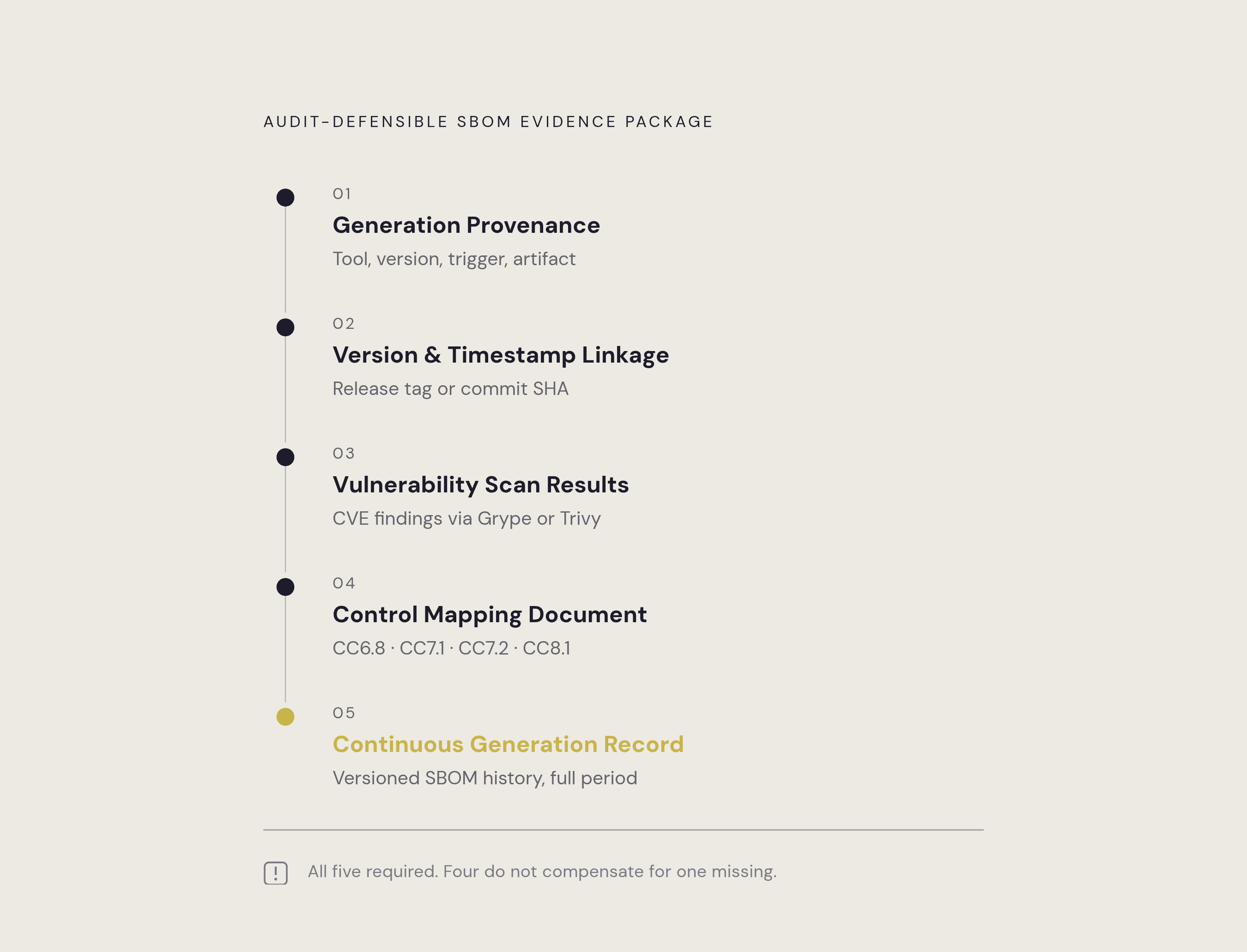
Generation provenance. The SBOM needs a record of how it came into being. This should include the tool used (such as Syft), the tool version, what triggered the build, and which artifact it was generated from. This answers the auditor's first instinct, which is to ask whether the process is repeatable or a one-off.
Version and timestamp linkage. Every SBOM has to tie back to a specific release tag or commit SHA, with a timestamp attached. Auditors sampling across a six-to-twelve-month window need to match the SBOM to whatever software version was actually deployed on the day they picked for testing. An SBOM with no version anchor is functionally useless during fieldwork sampling, no matter how thorough its contents look on the page.
Vulnerability scan results linked to the SBOM. A live scan run against a current CVE database, using something like Grype, Trivy, or OWASP Dependency-Track, tied directly to the SBOM at the moment it was generated. This is the actual CC7.1 and CC7.2 monitoring evidence: which CVEs were open, their severity, when they were triaged, and whether remediation got tracked. Auditors want that history, not a single "we ran a scan" statement. Nightly re-scans of components already deployed matter here too, since a package that was clean at build time can have a new CVE disclosed against it three weeks later.
Control mapping document. A written artifact connecting specific SBOM fields and scan results to the exact TSC controls they satisfy: CC6, CC7.1, CC7.2, CC8.1. Auditors do not draw this inference on their own, and assuming they will is one of the more expensive assumptions a compliance team can make. Without the mapping document, they see a file. With it, they see a satisfied control, and that difference costs nothing but the time to write it down.
Continuous generation record. Evidence that the SBOM program ran throughout the observation period, not just at the moment someone remembered the audit was coming. That means versioned SBOM storage tied to release tags, retrievable across the full window. A gap in that history is the software-inventory version of the access review that happened but was never saved, a recognizable Type II exception pattern.
Put together, these five components answer the four questions an auditor is actually asking: what was in the software, who authorized it, was it monitored, and can all of that be proven true for the entire period, not just for today. Miss any one of the five, and the other four don't compensate. That's what makes this a package rather than a checklist of independent nice-to-haves.
How to generate this package reproducibly inside the CI/CD pipeline
An evidence package assembled after the fact isn't credible, full stop. Reconstructing what was deployed three months ago, from memory or from scattered tickets, is not something fieldwork will accept, because the whole point of Type II testing is verifying that a control ran continuously. A reconstruction proves nothing about continuity, no matter how detailed it looks.
A 90-day build sequence works reasonably well for teams starting from nothing. In the first 30 days, instrument the CI/CD pipeline for the highest-risk or most customer-facing service so it auto-generates a CycloneDX SBOM on every build, using Syft or an equivalent tool, and validate the output against established minimum element requirements. Over the next 30 days, connect that pipeline to a vulnerability database, set up alerts for newly disclosed CVEs affecting inventoried components, extend SBOM generation to container images and additional software artifacts in use, and stand up central, versioned SBOM storage tied to release tags. In the final 30 days, write the control mapping document, covering PCI DSS 6.3.2, SOC 2 CC7.1, and the NIST SR family, and confirm the evidence record actually spans the intended observation window and can be pulled by release tag on demand.
Reproducibility is the quiet prerequisite underneath all of this, and skipping it is where most of these programs quietly fall apart. If the build environment changes between runs, the SBOM output can change too, even when the source code hasn't moved at all, and an auditor looking at inconsistent SBOMs across the observation period is going to ask why. The same configuration-drift risk that produces CC8.1 findings in production systems applies just as much to whatever environment is generating the SBOM in the first place. Declarative, version-pinned build environments, where every dependency and tool version is specified in code rather than installed by hand, remove that ambiguity. Tools like Nix flakes or Devbox capture the tool name and version automatically, simply because the environment itself is declared rather than assembled ad hoc.
Storing environment definitions and SBOM outputs in version control, in a GitOps pattern, gives auditors one retrievable record of what was deployed, when, and from which build. That single source of truth is what prevents the multi-spreadsheet mess that shows up when different teams keep their own inventories in different formats, and any team still running that way should treat it as a standing liability, not a backlog item. Adding provenance signing and supply-chain attestation puts a cryptographic layer on top of all of it. Auditors have no way to verify a plain timestamp on a file, but they can verify a signed attestation, and for teams selling into US federal supply chains, signed provenance alongside the SBOM has become an increasingly expected element of secure software delivery. Policy-as-code, meanwhile, catches unauthorized components before they ever reach production, turning CC6.8 detection into something automated rather than something discovered during an audit.
What the evidence package must demonstrate across a multi-framework audit
A compliance lead answering "what's running in your software" separately for PCI, SOC 2, ISO 27001, and NIST typically ends up maintaining four different spreadsheets, and at least one of them is out of date by the time anyone looks at it. That's the structural problem a single, well-built SBOM program is designed to solve. Building four separate tracking systems, one per framework, is the wrong instinct, even though it's the instinct most compliance teams default to.
The frameworks themselves are moving on different clocks. PCI DSS 4.0.1 Requirements 6.3.2 and 11.3.1.1 became mandatory on March 31, 2025, and QSAs now treat a maintained software component inventory as a hard requirement rather than a suggestion. ISO/IEC 27001:2022 Annex A controls 5.9 and 8.8 became mandatory to consider at the October 31, 2025 transition deadline, though which controls actually apply depends on each organization's own risk assessment; certificates still held against the 2013 version of the standard are no longer valid, and Annex A 8.8's vulnerability management expectations depend entirely on 5.9's asset inventory being current. SOC 2 CC7.1 and CC7.2 remain steady, with SBOM evidence increasingly accepted as supporting documentation. The HIPAA Security Rule update is still sitting as a Notice of Proposed Rulemaking as of August 2026, with its comment period closed since March 2025 and no final rule published, so nothing there is enforceable yet even if the direction is obvious. A federal secure software development framework has vendors held to SP 800-218 version 1.1, while a Revision 1 draft closed its comment period in January 2026; Executive Order 14306, issued in June 2025, removed CISA's central validation role and reverted the framework to self-attestation without mandatory artifact submission.
None of that regulatory churn changes the underlying data an organization needs to produce, a point most compliance teams miss when they build separate tracking systems for each framework. A single SBOM program, continuously generated, versioned, signed, and mapped to controls, satisfies the software inventory requirement across all five frameworks at once. What changes per framework is the mapping document, not the SBOM itself. Auditors increasingly expect that cross-framework alignment as a matter of course, with SOC 2 reports now routinely mapped against ISO 27001, HIPAA, GDPR, and DORA to avoid duplicating audit work. Organizations still treating each framework as its own separate evidence-collection project are paying that cost multiple times over, for no real gain, and there's no version of this that gets cheaper by waiting.
One extension worth planning for now: AI model components need the same treatment. An AI Bill of Materials applies the identical logic to record model versions, training datasets, data licenses, and evaluation artifacts, and it's increasingly tied to the EU AI Act and ISO/IEC 42001. Teams that already have an SBOM pipeline running have most of the infrastructure needed to extend it to AI components. The gap is organizational will, not technical capability.
Common ways SBOM evidence packages fail fieldwork, and how to prevent each one
The point-in-time SBOM is the most common failure, and it should surprise nobody. Someone generates it once, right before the audit submission, instead of continuously across the observation period. Auditors testing CC7.1 will ask for scan results from six months earlier and find nothing behind the request. Prevention is straightforward in principle, if not always in practice: tie generation to every build, store it with versioning, and make the SBOM history as retrievable as a git log.
The unlinked vulnerability scan comes next, and it's nearly as common. An SBOM file exists, technically, but no CVE scan results are attached to it, or the scan results live in a completely separate system with no traceable connection to the SBOM version they were run against. The fix is to generate the vulnerability scan in the same pipeline step as the SBOM itself, store both under the same release tag, and include a scan result summary alongside the SBOM in the evidence package rather than as a separate, disconnected artifact.
The unmapped artifact rounds out the pattern as the easiest of the three to prevent, which makes it the most frustrating to see in fieldwork. An SBOM gets handed to the auditor with no control mapping document attached, and the auditor is left to guess at its relevance to CC6.8, CC7.1, CC7.2, or CC8.1 on their own. That guessing does not happen in the auditor's favor. Fieldwork is not the place to make an auditor infer relevance for free, and any team still hoping otherwise is setting itself up for the same exception, audit after audit.


