Patch SLA Compliance Tracking for Critical CVEs
Measuring what's actually running beats reporting what you patched.
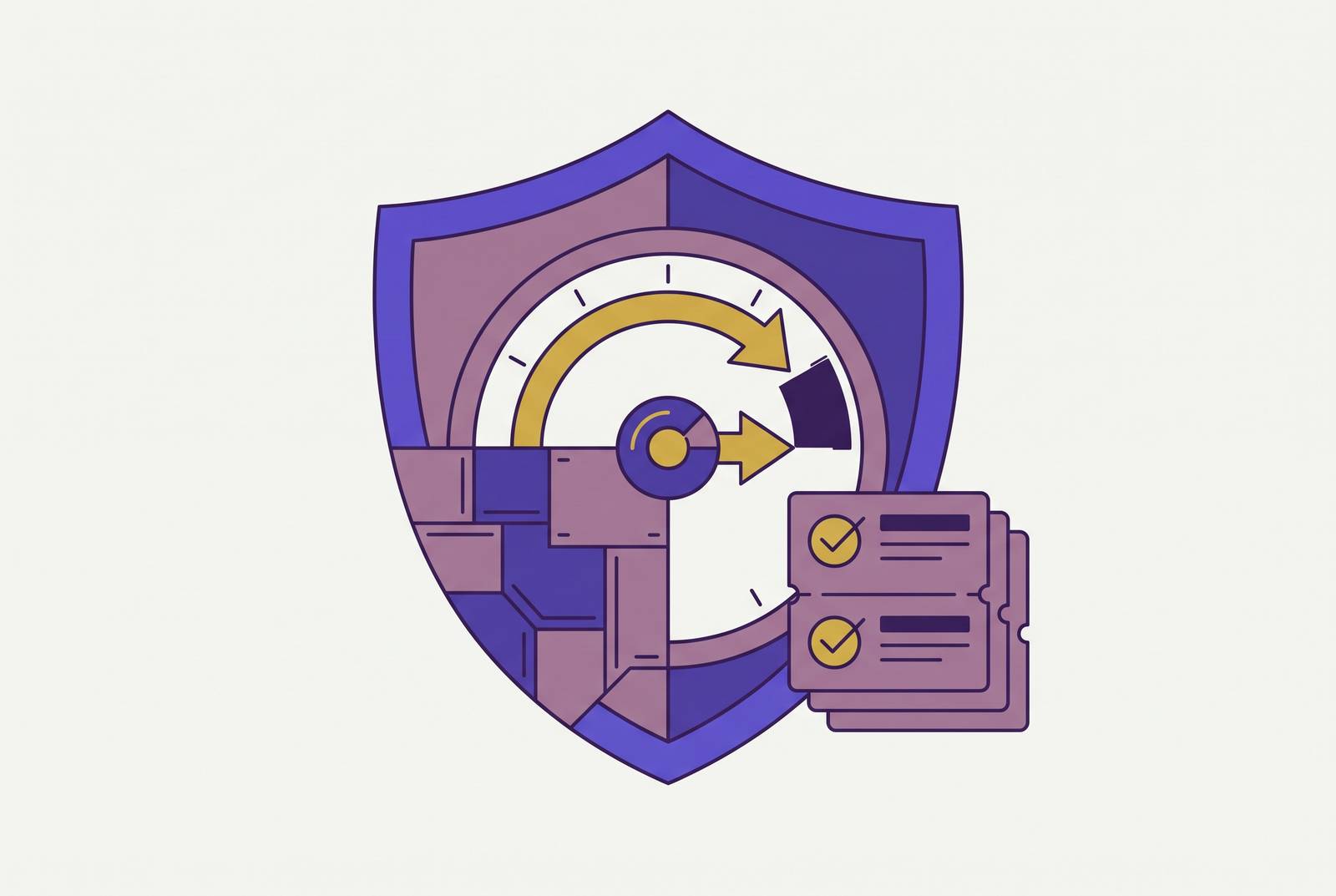
Over 28,000 CVEs were published in 2024, roughly 77 a day, so triage isn't optional anymore; it's the whole job. Most patch SLA programs fail because the environments underneath those dashboards are inconsistent and unprovenanced: nobody can say with confidence what's actually running, where it's running, or whether a given patch actually landed on it. Fixing that requires reproducible, inventoried environments, not better reporting layered on top of the same shaky ground.
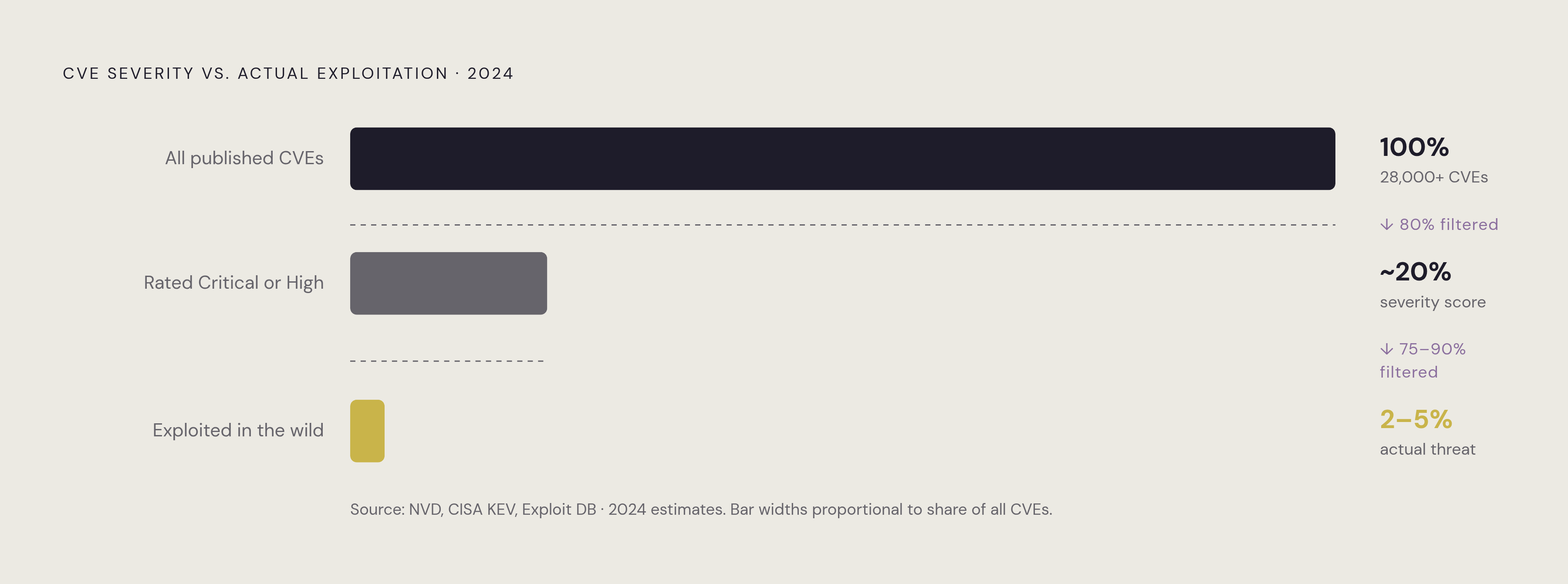
Roughly 20% of published CVEs get rated Critical or High, but only 2 to 5% are ever exploited in the wild. That gap between severity rating and real-world risk is where most remediation capacity gets wasted, chasing scores instead of actual exposure. The old calibration for SLA tiers, critical within 30 days and high within 60, assumed exploit development took days or weeks after disclosure. Exploit development timelines have shortened significantly, and CISA's Known Exploited Vulnerabilities catalog continues to add entries at a pace that traditional patching cycles struggle to keep up with. A 30-day window used to be a safety margin. Now it's closer to a liability floor, and as this piece will show, even hitting that floor reliably is harder than most programs assume.
What a patch SLA program has to measure to be meaningful
The headline number is patch compliance rate by criticality bucket: what share of critical CVEs got remediated inside the SLA window. Compliance rates below 85% for critical patches within 30 days are common across the industry, and anything under 95% signals the program needs tooling or process work before anyone should call it effective.
That single number hides a lot, though. Mean time to remediate by tier, patch failure rate, and the percentage of assets actually running a scanning agent all matter, and all of them need to be broken out by asset class. Servers, workstations, cloud instances, and containers behave very differently under patch pressure, and averaging across them hides the environment that's actually failing.
CISA's Binding Operational Directive 22-01 sets a federal floor worth studying even for organizations it doesn't legally bind: 14 calendar days to remediate KEV entries for CVEs assigned after 2021, six months for older ones, with no exception for whether the asset faces the internet. Chainguard's published CVE SLA policy goes further, targeting KEV-listed vulnerabilities within one calendar day of a qualifying patch becoming available, Critical within seven days, and High, Medium, and Low within fourteen. PCI DSS asks for one month on critical or high-severity patches, but treat that as a floor, not a target. An internal SLA for anything KEV-listed should be seven days or under.
Watch for the "calendar days" trap, too. SLA clocks don't pause for weekends, and a patch released Thursday evening against a Tuesday-only maintenance window has already burned four days before the first eligible deployment slot even opens.
CVSS alone isn't a good enough filter anymore. Pairing it with a standardized system that scores exploit prediction, and tracking on-time remediation specifically for the known-exploited-vulnerabilities list and findings with a score above 0.10 on that system, gives a much more actionable, exploitability-weighted view of where the real risk sits. Exceptions deserve their own ceiling: they should stay under 5% of Critical and High findings, and if that number is climbing, it means SLAs are quietly becoming optional. Framing matters when this data reaches engineering teams, too. "Pre-auth RCE on an internet-facing service, working exploit published three days ago" moves people. A bare CVSS score doesn't. SLA compliance works best when it's treated as a delivery metric.
Knowing your SLA target does not tell you whether you hit it.
Setting a target is the easy part. The harder question, which most programs quietly fail to answer, is whether the patch actually took effect on the systems that needed it.
A patching record typically conflates three distinct states: a patch applied to a build artifact, a patch pushed to a registry or package store, and a patch actually running in production. Those are not the same fact, even though most reporting treats them as interchangeable. If the dependency inventory behind that reporting is incomplete or stale, the organization can't even reliably say which systems were affected by a given CVE in the first place, so the SLA clock's start time is itself a guess.
Inconsistent environments make this worse. The same package might appear at one version in one team's build and a different version in another's, with nothing canonical to arbitrate which one is authoritative. Absent a provenance record linking a running artifact back to a known build, "patch applied" is an assertion someone typed into a ticket, not a fact anyone verified.
This is not solvable with a better dashboard. A more polished report sitting on top of an inconsistent environment just produces confident-looking numbers that don't match reality, and confident wrong numbers are worse than obviously incomplete ones. The rest of this piece follows that logic in order: containers first, because that's where the compliance gap is most visible and easiest to measure, then the incomplete dependency inventory beneath it, then the environment reproducibility fix that actually addresses things.
Container fleet patching creates a specific, measurable compliance gap
Running a tool like Copa against 200 images on a nightly cron job produces patch activity. It does not, by itself, produce compliance, and that distinction is where most container patching programs quietly go wrong.
Real compliance means answering four separate questions at once. Which images currently carry critical CVEs in the registry? Which of those images have been running with a critical CVE longer than the SLA allows? Which patch runs failed silently, leaving images untouched? And, the one most teams miss entirely, which running Pods are still executing an unpatched image digest even after the registry version got fixed?
That last question exposes a structural fact about Kubernetes: Pods aren't automatically recycled when the underlying image changes. Patching the registry tag does nothing for a workload that's already running from an older digest. A compliance system that only checks registry state, and never checks what's actually executing in the cluster, will happily report a CVE as remediated while the exploitable container keeps serving traffic.
Silent job failure is the second trap. If a nightly patch job fails because of a registry push error, a scanner timeout, or a misconfigured RBAC token, the SLA clock keeps running and nobody gets paged. A typical observability stack for this problem pairs a patching tool run as a CronJob with Trivy for scanning, Prometheus and Grafana for metrics, and sometimes OWASP Dependency-Track to hold remediation history.
Five metrics do most of the real work here. image_cve_age_hours tracks how long a CVE has sat on a given image digest. copa_patch_success_total and copa_patch_failure_total, broken out by image and failure reason, catch the silent failures. image_patch_sla_breach_total counts breaches against threshold. running_containers_with_critical_cve, keyed by namespace and digest, answers whether the cluster itself, and not just the registry, is clean.
None of this works if image references aren't normalized. A mismatch between how a patch job logs an image reference and how Kubernetes records it in the Pod spec is the single most common cause of false negatives in compliance tracking, so using full registry hostname and digest references, rather than floating tags, is essential. It looks patched. It looks patched, but it isn't.
This isn't a niche concern. The CNCF's 2025 Annual Survey found 82% of container users run Kubernetes in production, which makes this the dominant deployment model, not an edge case. GitOps adoption compounds the stakes: a large share of organizations were using or planning to use GitOps as of 2025, and tools like Argo CD and Flux CD, both CNCF graduated projects, automate reconciliation so a patch commit triggers deployment almost immediately, shrinking the gap between "patch available" and "patch running." On the image side, Docker's Hardened Images initiative, announced in May 2025 and expanded with over 1,000 images released free and open source under Apache 2.0 in December 2025, points at a complementary strategy: smaller, purpose-built images give attackers, and compliance teams, less surface to track.
Why the dependency inventory problem precedes the patching problem
None of the container-level fixes matter if nobody knows what dependencies are actually in the fleet to begin with. Software supply chain attacks caused significant harm globally in 2025, with over 70% of organizations reporting at least one incident tied to third-party software that year.
The dependency surface itself has become genuinely hard to track. Sonatype identified more than 454,600 new malicious packages in 2025 alone, pushing the cumulative total past 1.2 million. That's not a long tail problem anymore; it's the whole distribution. And yet the actual breach data from 2025 shows concentration, not sprawl: SecurityScorecard found that 63.5% of vulnerability-based breaches traced back to just two CVEs in file transfer software. Most of the risk sits in a small number of widely deployed dependencies, not spread evenly across the ecosystem. Third-party access shows up again in ransomware: SecurityScorecard's 2025 data put 35.5% of breaches down to third-party vulnerabilities, and 41.4% of ransomware infections exploiting outdated software from partner ecosystems.
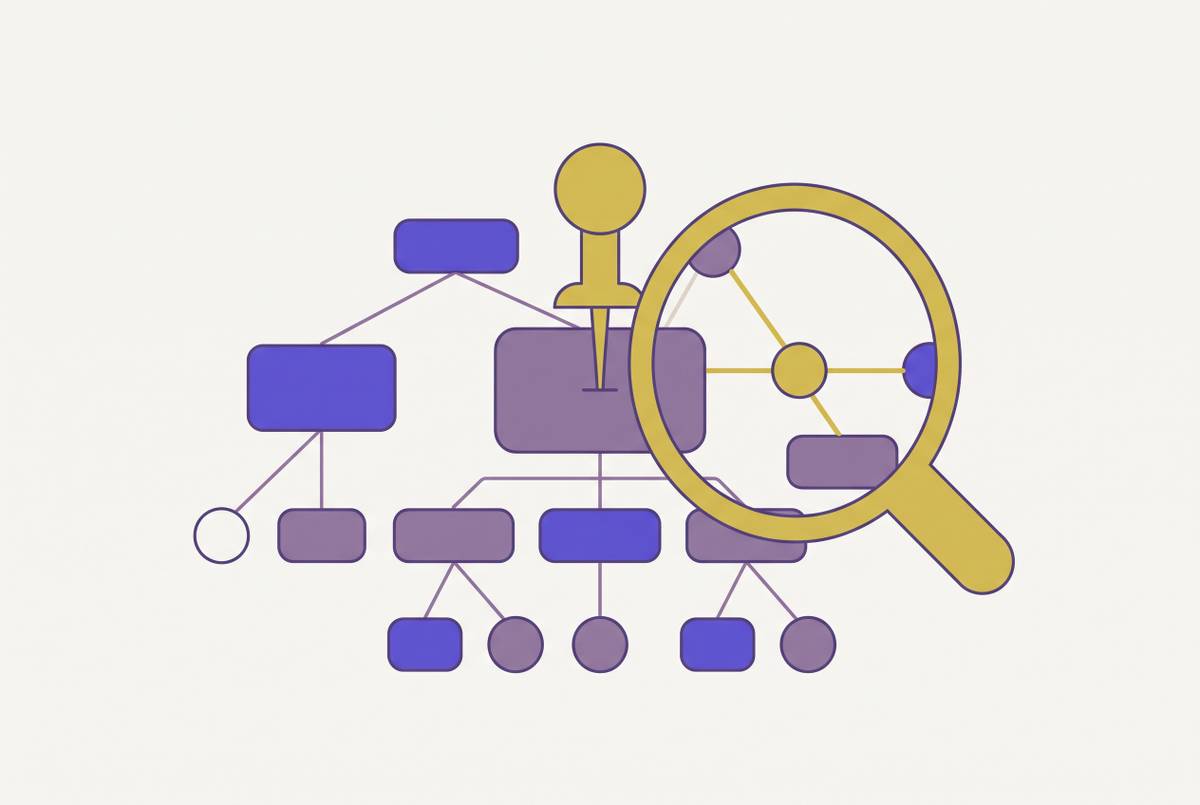
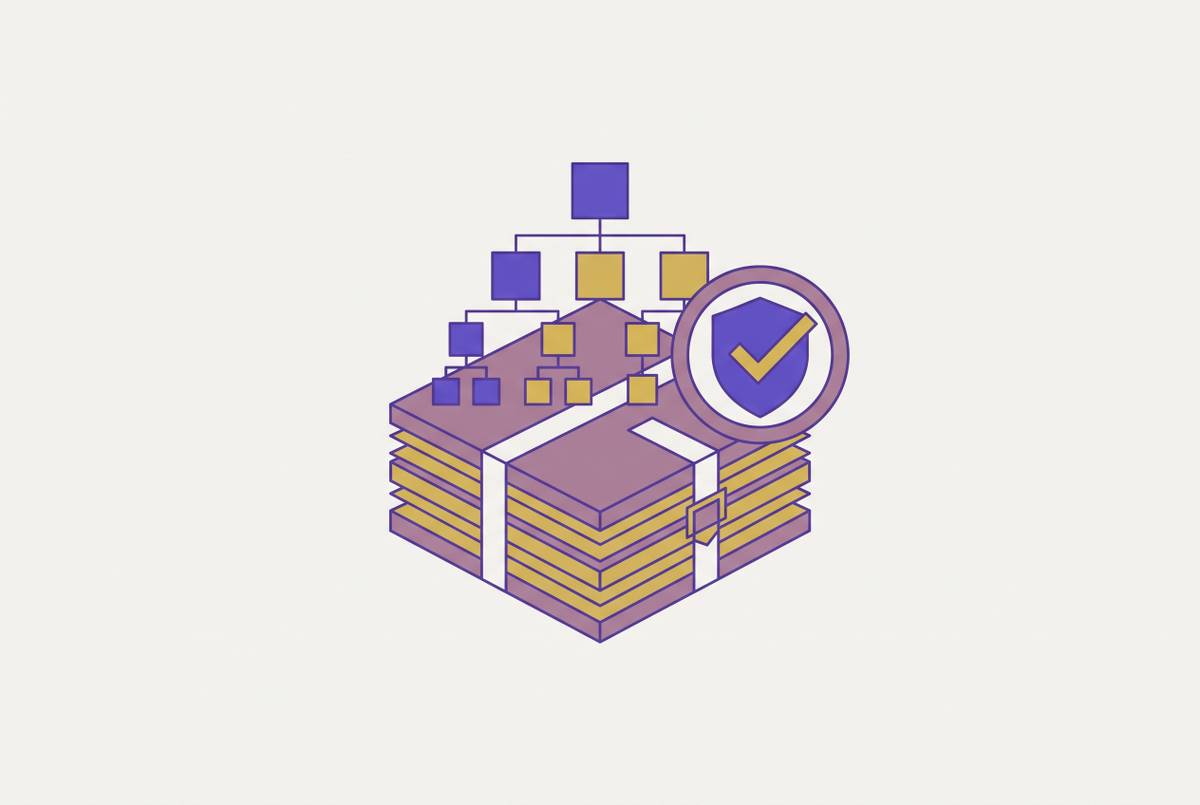
An inventory of every software component in a system, maintained as a formal artifact, is the operational answer to the "what do we even have" problem. Maintaining a real inventory of every third-party component is what lets a security team look at a new CVE and immediately know which systems are affected and which vendors need a call, rather than waiting for a scanner to stumble across it. Without that inventory, the SLA clock can't start on time, because awareness itself is delayed until a scan happens to hit the vulnerable component.
Software composition analysis tools that run on every commit or build, rather than at some periodic audit, are the practical version of this. Regulation is pushing in the same direction: one federal directive already requires this kind of component inventory for software sold to federal agencies, the EU's Cyber Resilience Act extends SBOM-related obligations, and regulatory pressure continues to grow around what such an inventory must contain. SBOMs are moving from a nice-to-have into a procurement requirement, and programs that treat them as optional now will be retrofitting them under a deadline later.
One failure mode deserves its own callout: an SBOM generated once at release time and never refreshed doesn't describe what's running, it describes what was built. Those two things drift apart in production the moment nobody's watching, and without environment controls, nobody is.
How environment inconsistency undermines every layer of patch compliance
Environment drift is the quiet mechanism behind almost every failure described above. The same codebase can run on different dependency versions across a developer's laptop, the CI pipeline, staging, and production, and a patch applied in one of those places doesn't propagate to the others on its own.
"Works on my machine" is usually treated as a joke about developer tooling. It's actually an infrastructure problem with an infrastructure answer: if environments aren't reproducible from some canonical specification, there's no single ground truth anyone can point to for what's actually running. Mutable infrastructure makes this structural, not incidental. If patching a fleet means remotely logging into boxes and running package upgrades by hand, it requires available engineers, a scheduled maintenance window, and manual verification afterward, none of which is compatible with a sub-24-hour SLA.
Immutable images change the shape of the problem. Patching changes from something done to a running system into a deployment operation: rebuild from a pinned, auditable specification, then redeploy. That shift is the architectural prerequisite for any SLA tracking that wants to be trustworthy rather than aspirational. Pinning to a digest instead of a tag is the same idea applied one layer down. FROM debian:bookworm@sha256:1234abc... names a specific, verifiable artifact. A floating tag names a moving target that might be a different image tomorrow.
The provenance gap causes all of it: without a build record tying a running digest back to the exact dependency graph that produced it, "this system is patched" is something someone believes, not something anyone can check. Without a build record tying a running digest back to the exact dependency graph that produced it, "this system is patched" is something someone believes, not something anyone can check. Reproducible environments with explicit dependency manifests, where every package, version, and hash is declared and locked, are what turn an SBOM from a document generated for an audit into a live, queryable inventory.
This extends past production. If a new developer's laptop or a CI runner resolves dependencies differently than production does, that's untracked divergence a scanner may never catch, because it's only looking at the environments it's been told to look at. Cross-platform reproducibility matters for the same reason: a patch verified on x86 Linux but never checked against the ARM build actually running in production leaves a blind spot the SLA program has no way to see. The organizational fix here tends to be a platform engineering team maintaining extensible, canonical base environments that developers build on top of, rather than a rigid top-down mandate that just pushes people toward workarounds and shadow dependencies nobody tracks.
Building a patch SLA program that can verify compliance
None of this starts with a dashboard. It starts with a reproducible, inventoried environment where "what's running, and at what version" is a query with one deterministic answer based on verified data, rather than a guess based on whichever report someone pulled last.
Four layers do the actual work. Dependency declaration means every environment specifies its packages and versions explicitly, digests included, committed to source control, so the SBOM gets generated from that declaration rather than reconstructed after the fact. Build provenance means CI produces a signed record tying the running image back to its exact dependency graph, which is what makes a patch verifiable instead of merely asserted. Deployment state tracking means compliance queries actually check cluster state, the running digest, not just registry state, closing the exact gap the container section walked through. And SLA clock management means CVE awareness starts from a lookup against the live SBOM, rather than from whenever a scanner happens to notice, which eliminates the lag between publication and response.
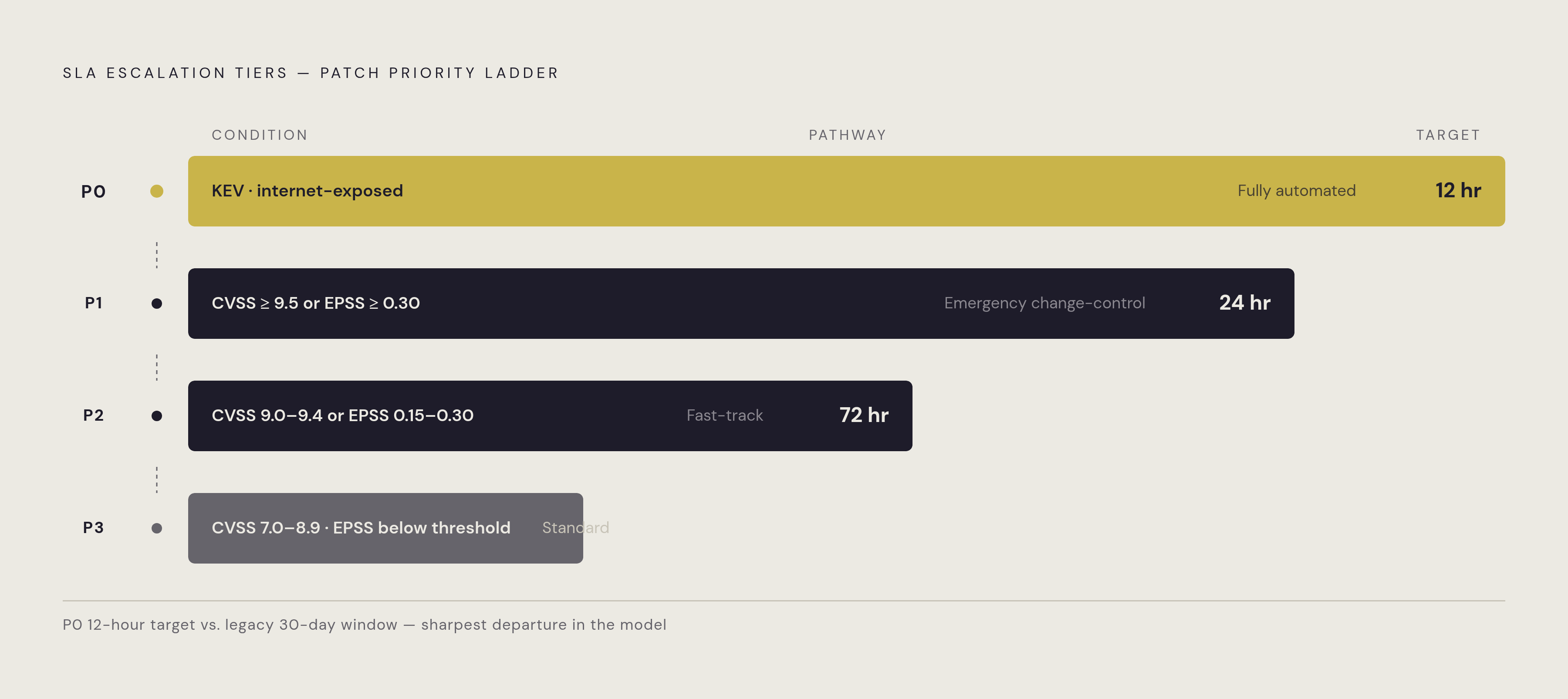
On top of that foundation, SLA tiers can get sharper and more automated. KEV entries on internet-exposed assets, call it P0, get a 12-hour target with a fully automated deployment path. A CVSS score of 9.5 or higher, or an EPSS score of 0.30 or above, call it P1, gets 24 hours with automation plus an emergency change-control path. CVSS 9.0 to 9.4 or EPSS between 0.15 and 0.30, P2, gets 72 hours on a fast-track process. CVSS 7.0 to 8.9 with EPSS below threshold, P3, gets a standard seven-day process.
That 24-hour P1 target cannot survive contact with a weekly change advisory board, so an emergency change-control pathway, a security-exception track that bypasses the normal weekly cycle for P0 and P1 patches, has to exist alongside the standard process. Staged rollout with automated health gates is what makes that safe: it removes a human approval step from the hot path while still preserving the ability to roll back fast if a patch introduces a regression, which is exactly the failure mode this whole structure has to guard against.
Reporting belongs with engineering leadership, alongside deployment frequency and reliability numbers, not buried in a separate security report nobody outside the security team reads. That placement reinforces the framing: SLA compliance is a delivery metric, and it should live where engineering accountability already lives. Exception governance closes the loop. Fewer than 5% of Critical and High findings should carry an active exception, and every exception needs a documented compensating control attached to it. A critical patch that misses SLA without paperwork behind it is a control failure the moment an auditor looks at it.
AI coding agents and automated pipelines need the same environment discipline as human developers, not less. An agent that resolves dependencies at runtime against an unpinned specification introduces exactly the same drift that undermines human-authored environments, just faster and with less anyone noticing.