CIS Software Supply Chain Security Guide Alignment
Pinned, declarative environments connect the guide's five domains across the software lifecycle.
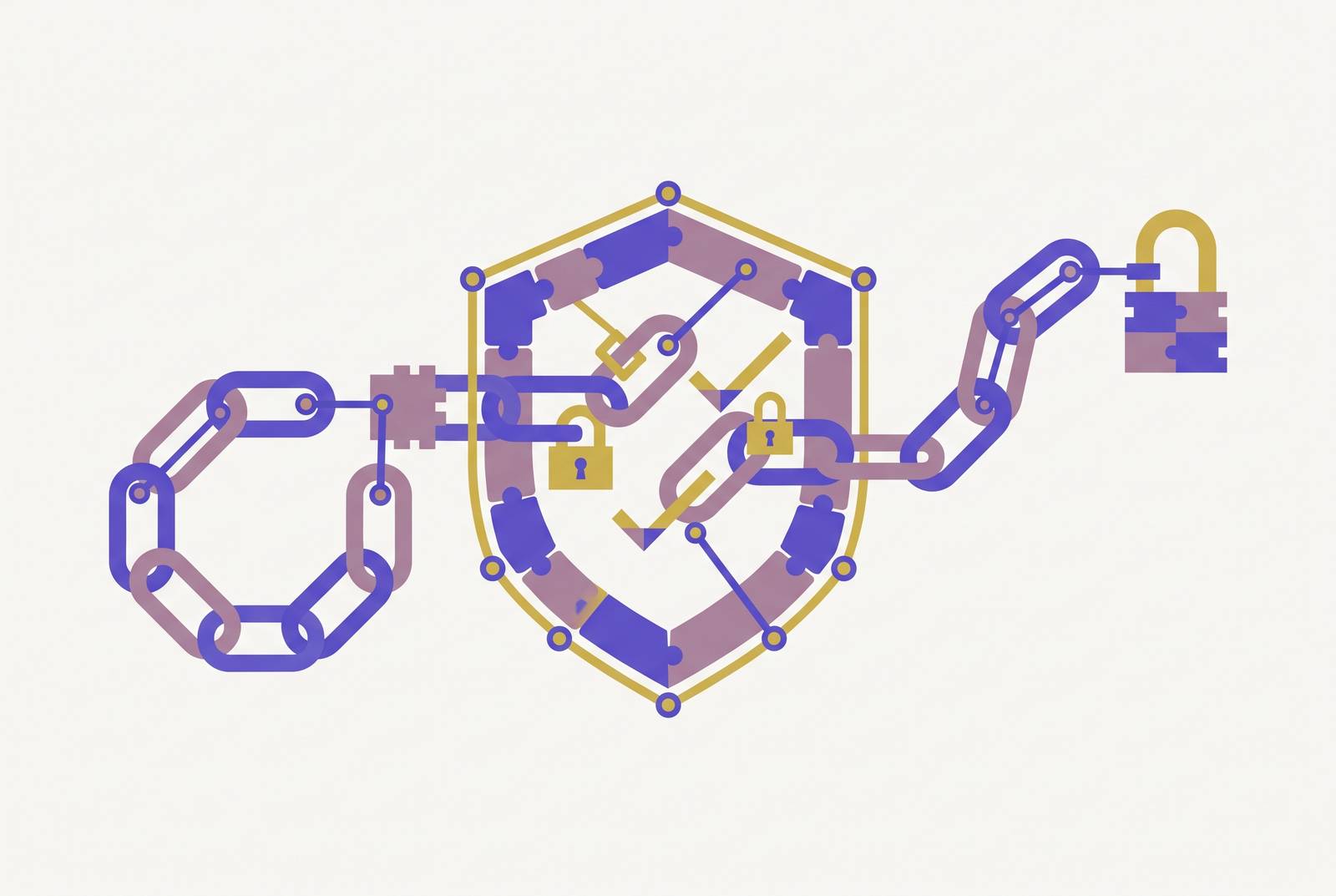
Aligning with the CIS Software Supply Chain Security Guide means connecting its controls through the environments in which software is written, built, and deployed. Pinned, declarative environments provide that connection. They make the toolchain reviewable, the build repeatable, and the path to production traceable across all five of the guide’s domains.
Why the CIS Software Supply Chain Security Guide is the right framework to build on
The CIS Software Supply Chain Security Guide provides more than 100 foundational recommendations across five domains, namely Source Code, Build Pipelines, Dependencies, Artifacts, and Deployment. That structure follows software from first commit to production rather than treating the finished application as the sole object of security. Its consensus process draws on consulting, software development, audit and compliance, security research, operations, government, and legal perspectives. The framework gives teams that do different work a shared way to govern the supply chain.
The guide is deliberately platform-agnostic and serves as a parent framework for platform-specific benchmarks. Organizations can therefore still follow its principles when they change their toolchain. CISA, NSA, and the Office of the Director of National Intelligence reinforce this lifecycle approach through their Securing the Software Supply Chain series, including SBOM guidance. Within that lifecycle, each CIS domain has a reproducible-environment dimension.
The connective tissue the guide assumes but does not supply: reproducible, declarative environments
The CIS controls presuppose a trustworthy environment without supplying a single method for creating one. Code review, pipeline integrity, dependency governance, artifact provenance, and deployment validation all depend on knowing what surrounds the application. When that context is undeclared, each control rests on an assumption that the next stage may not share. Pinned, declarative environments are the connective tissue the framework needs. They give the five domains a common, versioned account of the tools and inputs under their control.
Unpinned transitive dependencies and unmanaged system libraries can change how source code behaves, destabilize build workers, and make dependency graphs unreliable. Those changes then weaken artifact provenance and introduce differences at deployment. A repository can remain unchanged while the environment around it changes the result. Controlling only the repository therefore leaves part of the software supply chain outside the review boundary.
Treat environments as disposable and reproducible rather than patching long-lived installations indefinitely. Teams rebuild from a known, versioned configuration that declares the full toolchain, including OS packages, language runtimes, and shell configurations. That declaration replaces manual instructions with an artifact that can be reviewed, diffed, and rolled back. Pinning holds the chosen inputs in place, and governance sets the rules for changing them.
Domain 1 — Source Code: version-controlled environments make code integrity controls enforceable
Version control of code without version control of its environment is half a control. The CIS Source Code domain requires teams to track changes, scan for risks at merges, and control who can contribute through strong authentication. Those controls govern who can change the repository and how changes are assessed. Yet assessment also depends on the tools that contributors run. If the same checkout behaves differently on two machines, the repository alone is an incomplete source of truth.
A declarative environment manifest checked into the repository extends the review boundary to the developer toolchain. OS packages, language runtimes, linters, and secret-scanning hooks become versioned inputs. Contributors who use that manifest run the same declared pre-commit controls. A reviewer can then assess a toolchain change as part of the change set instead of assuming that every contributor has followed the same installation instructions. This lets peer review cover more of the change within the same basic workflow.
The CIS guide specifically calls for scanning code for sensitive data and secrets. When those scanners are declared in the environment, reviewers can check which ones are there and how they are configured, taking that setup out of each developer’s hands. The same principle supports the guide’s treatment of third-party application risk in repositories. An unapproved tool cannot become part of the pinned manifest without a visible change to that manifest. Environment version control gives access controls and scanning a consistent developer-side foundation.
Domain 2 — Build Pipelines: immutable build environments are a CIS requirement, not a nice-to-have
The CIS Build Pipelines domain explicitly recommends immutable pipeline infrastructure and configurations. It covers build environments, build workers, pipeline instructions, and pipeline integrity. Here, the guide’s language and reproducible-environment practice converge directly. Immutability means the worker’s environment has a state defined by a declared specification that can be recreated for each run.
The guide also calls for single-use build workers and segregation of duties. Rebuilding a worker from pinned inputs prevents it from accumulating state across jobs. Defining that worker for its assigned role keeps duties separate as the guide requires and keeps unrelated work out of a general-purpose environment. Runtime security monitoring then has a known baseline against which to assess behavior. Without that baseline, the distinction between an expected tool and an unexpected change is harder to establish.
The guide’s pipeline integrity controls also require reproducible artifact production. An environment that changes independently of the source cannot provide a reliable basis for that requirement, because a drifted toolchain may produce a different binary. Reproducibility must therefore cover both the pipeline instructions and the environment they run in. Declaring, pinning, and reviewing the pipeline environment also cuts the need for manual configuration, which can bring hard-coded secrets and inconsistent setup into the process.
Domain 3 — Dependencies: pinning is the minimum; governed transitive graphs are the standard
A pinned build environment must account for what its dependencies pull in. One direct dependency can introduce dozens to hundreds of transitive dependencies into the final build. Those indirect relationships complicate remediation because a fix may depend on an intermediate maintainer. They can also differ across development, test, and production environments. Pinning the top-level package is therefore only a starting point for controlling the graph that actually reaches the application.
A governed graph makes the full set of inputs visible and subjects updates to review. Build-derived SBOMs link that graph to the software the build produces, using more than the declared metadata alone. A declaration says which inputs should go into the build, while the actual build output records what went in. A reproducible environment with a pinned, input-derived hash makes it possible to re-derive the corresponding SBOM deterministically. Hash-level traceability then links the evidence about dependencies to the state of a given environment.
The CIS Software Supply Chain Security Guide recommends that dependencies be no older than 60 days. Pinned references make dependency age auditable and give updates a defined review surface. Pinning is not an instruction to freeze dependencies indefinitely, since that would conflict with the need to keep them current. Each update makes a clear change to a known graph. Reviewing those changes also supports governance of open-source package ownership risk, although a changed hash is a signal to examine the changed inputs and determine why they changed.
Domain 4 — Artifacts: signed, reproducible artifacts require a chain of custody that starts at the environment
Artifact signing and SBOM attestation depend on evidence established before release. A signature identifies the signer, but it does not establish that the producing environment was clean, pinned, or free of drift. Signing an artifact from an undeclared environment leaves a gap in its chain of custody. The artifact has an authenticated release step without a fully traceable production context. Reproducibility addresses that gap by making the environment and its inputs available for reconstruction.
When declared build inputs produce a deterministic hash, that hash can be attached to the artifact at release time. It becomes an identifier that connects the released output to the inputs used to produce it. A newly disclosed CVE can then be cross-referenced against those inputs to locate affected artifacts without rescanning images. The useful property is not the hash in isolation, but the traceable relationship it represents.
The same dependency applies to SBOM attestation. An SBOM from a non-reproducible build may describe an artifact that changes when the build runs again. It cannot simply be carried forward as evidence for that different output. Reproducibility provides the basis for deriving consistent component evidence from the same inputs. Signing and attestation then bind release evidence to a known production process.
Domain 5 — Deployment: environment consistency across dev, CI, and production eliminates the trust gap at the boundary
The build-to-runtime boundary is a common place for supply chain trust to break. When build and runtime environments are independently managed and undeclared, a compliant build can enter a non-compliant runtime without the difference being detected. Deployment validation cannot resolve that problem by inspecting the application artifact alone. The environment receiving it is also part of the security decision. To prevent tampering and keep production secure, teams need continuity between the approved build context and the deployed state.
A shared declarative specification makes that continuity observable across developer laptops, CI runners, and production runtimes. Deviations from pinned inputs appear as hash mismatches that can be caught before promotion. Environment promotion can then follow the same version-control and review workflow as application code. Removing manual reconstruction from the handoff and the inconsistencies it introduces makes the deployment decision concern a known specification.
Heterogeneous infrastructure adds another boundary to that decision. Support across Linux and macOS, x86-64 and ARM must preserve the declared environment’s intended consistency rather than allowing platform differences to become unmanaged exceptions. Otherwise, success in CI still leaves uncertainty about production. The five CIS domains are therefore not merely sequential checkpoints that can be closed independently. They are overlapping concerns, and a consistent environment specification is the mechanism that addresses their shared environmental requirements at once.
What a CIS-aligned reproducible environment practice looks like end to end
An end-to-end practice treats the environment manifest as the unit of promotion. Source control holds it with the application, the build worker runs from it, and dependency governance reviews the graph it pins. The artifact has an input-derived hash, and production gets the same approved specification. Each stage uses the preceding stage’s evidence. This is one discipline applied across five domains.
Contributors start this practice by pulling one versioned environment in place of following a multi-step README. The declared toolchain makes onboarding consistent with the Source Code controls from the outset. AI coding agents can use the same pinned toolchain and reviewed manifest as human developers. The control follows the environment in which code is produced, regardless of who or what contributes it.
Platform engineers can build on this model by publishing versioned base environments in an internal catalog. Application teams can then use self-service to follow the shared practice without building the base environment themselves. Versioned generations also make rollback atomic, turning a return to a known-good state into a single operation. That helps teams follow the incident response workflows behind the guide’s controls and keep traceability through recovery. The CIS guide supplies the “what” across five domains, and reproducible environment practice supplies the “how” that makes their shared requirements tractable at once.