FedRAMP Continuous Monitoring SBOM Requirements
FedRAMP's 2026 rules make software bills of materials mandatory operational evidence.
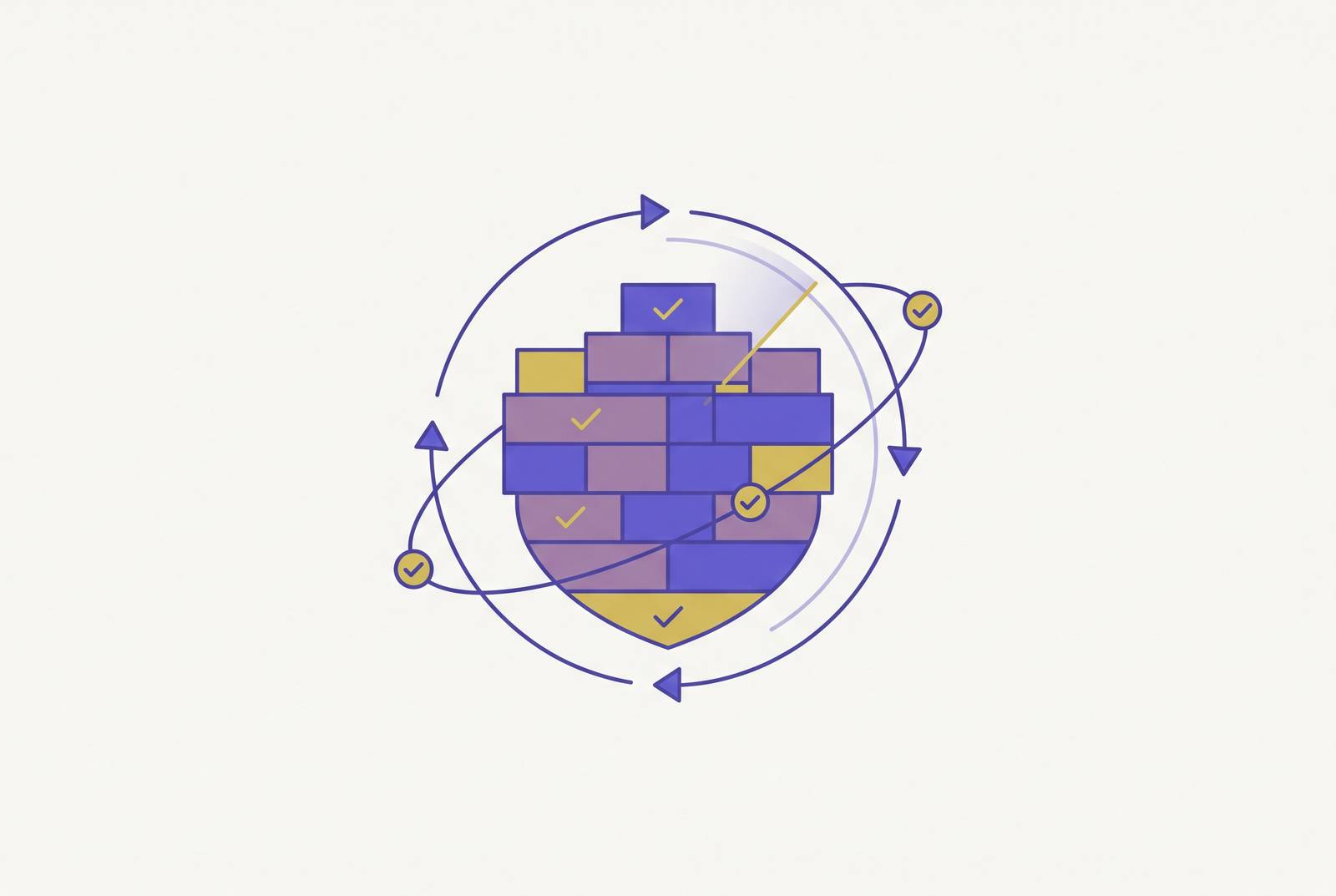
FedRAMP Continuous Monitoring SBOM Requirements now cover more than an inventory sent in for assessment. FedRAMP’s 2026 Consolidated Rules recast continuous monitoring as Ongoing Certification, making software bills of materials structural inputs to automated assurance. The engineering consequence is direct. An SBOM must be generated with the software, maintained as it changes, and connected to vulnerability evidence.
Why FedRAMP stopped calling it "continuous monitoring" and what replaced it
FedRAMP explains that “Continuous Monitoring” had become a synonym for vulnerability scans, while the new requirements are materially wider. The old model centered on monthly scan uploads, a Plan of Action and Milestones (POA&M), an annual assessment, and significant change requests routed through FedRAMP PMO. Ongoing Certification instead establishes six assurance rulesets containing 76 rules, with a parallel vulnerability detection and response ruleset. Certification Classes A, B, C, and D take the place of the FedRAMP Ready/Low/Moderate/High designations. The governing principle is automated validation for the large majority of requirements, with machine-readable evidence wherever a rule defines a schema.
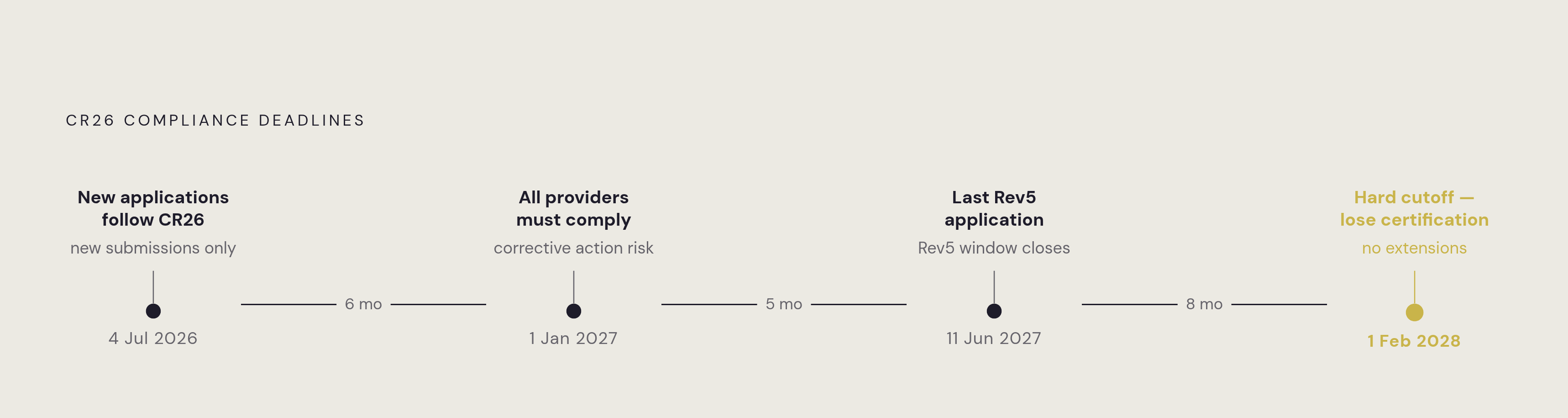
The transition has firm dates. New applications under the updated framework must follow CR26 as of 4 July 2026. All providers, including new Rev5 applications and active Rev5 and 20x offerings, must follow CR26 by 1 January 2027 or face requests for corrective action. The last new Rev5 applications are accepted on 11 June 2027. All grace periods expire on 1 February 2028, when noncompliant offerings lose certification, with no extensions past the default grace period.
What the six Ongoing Certification rulesets actually govern
The six rulesets separate assurance into domains with distinct actors and cadences. Addressing FedRAMP Communication (AFC) has 8 rules for security contacts, urgent communications, response-time testing, and how to route messages separately from support. Incident Evaluation and Communication (IEC) has 7 rules for incidents that must be reported, with as little as 15 minutes to report them based on their incident rating. Independent Verification and Validation (IVV) has 9 rules for how independent assessment must work in place of the periodic 3PAO assessment cycle. Significant Change Notification (SCN) sets out the categories of significant change and how agencies must be told about them.
The remaining two rulesets create the most direct demand for current component data. Collaborative Continuous Monitoring (CCM) centers on the quarterly Ongoing Certification Report (OCR) and Quarterly Reviews. Vulnerability Evaluation and Reporting (VER) governs whether vulnerabilities are likely to affect federal customers and how their status is reported, including class-keyed evaluation timeframes. The parallel Vulnerability Detection and Response (VDR) ruleset sets class-specific detection and response timeframes. It requires 20x Class C providers to verify and validate the status of machine-based resources at least every three days, while Rev5 Class C providers must do so monthly. These seven rulesets are not the full CR26 catalog.
Where SBOMs were implied under Rev5 and where they become explicit under 20x
Under Rev5, SBOMs help providers meet the required outcomes, though the rules do not name them as required artifacts. CM-8 requires providers at all baseline levels to keep an accurate, up-to-date system component inventory. SA-9 calls for supplier relationships that support a chain of trust, for which supplier SBOMs provide a practical mechanism. RA-5 and SI-2 call for vulnerability monitoring and flaw remediation, while IR-4 and CA-7 require providers to find affected components quickly. In each case, an SBOM supplies useful evidence, but the control does not itself name an SBOM requirement.
Under the updated framework, the SBOM is a named input to a Key Security Indicator. That changes the obligation from demonstrating an outcome through an optional artifact to maintaining named, structured evidence. Scope remains an important interpretive question because none of the KSIs use the words “dependency,” “open source,” or “package.” On a plain reading, however, a third-party library inside a service is third-party software under KSI-SCR-MON. Engineering teams therefore cannot assume that coverage stops at separately procured products.
What a compliant SBOM must contain and which formats FedRAMP recognizes
FedRAMP’s adopted content standard follows CISA’s 2026 Minimum Elements publication. The minimum elements include supplier name, component name and version, dependency relationships, license information, timestamp, and the tool that created the SBOM. Accepted formats are SPDX (ISO/IEC 5962:2021) or CycloneDX, covering commercial, open source, and custom components. Version information allows vulnerability correlation because a component name alone cannot show whether a specific CVE affects software that is deployed. Dependency relationships must include transitive dependencies, which are the packages that a direct dependency pulls in.
An SBOM missing those transitive dependencies is not compliant evidence, regardless of its format. CR26 also requires automation to keep human-readable and machine-readable versions consistent wherever a rule defines a schema. For SBOMs, the JSON output must validate against FedRAMP’s schemas. Some technical details, including the full set of required fields, have yet to be published during rollout. Teams should therefore monitor FedRAMP’s schema publications rather than treating format selection as proof that the artifact meets every requirement.
How SBOMs feed the VER and CCM rulesets as operational evidence, not documentation artifacts
VER depends on knowing exactly which components and versions are deployed. To assess federal customer exposure, it requires evidence of agency impact, exploitability, and reachability, rather than relying only on standardized vulnerability severity scores. A complete SBOM provides the component foundation for that judgment, although it does not by itself establish every aspect of risk. If the inventory is stale, the provider cannot reliably defend the relationship between a finding and the deployed service. For 20x Class C providers, the three-day resource verification cadence makes that freshness operationally significant.
CCM carries the resulting vulnerability state into the quarterly OCR. The report must include accepted vulnerabilities and planned changes over the next three months. When a planned dependency update or component swap occurs, the SBOM must change then, including between reports. The OCR’s JSON must also validate against FedRAMP’s schema.
Container rules make the link between inventory and deployment still more exact. The FedRAMP Continuous Monitoring Playbook, v1.0, November 2025, allows containers to be actively deployed only if their images were scanned within a 30-day vulnerability scanning window. That window begins when the container is deployed to the production registry. Configuration changes and software patches must be made on the replacement image and must never be made directly in production. Each replacement therefore needs a fresh SBOM tied to the build it came from.
Accepted Weaknesses replace the POA&M model. A finding left open beyond its required remediation window becomes an Accepted Vulnerability in the OCR. Accurate component data makes the distinction between accepted and remediated findings defensible. Coverage limited to primary application containers leaves gaps when Redis deployments, Nginx instances, or monitoring agents remain undocumented. Those omissions can undermine both the Accepted Weaknesses List and VER evidence.
Why build-time SBOM generation is the only reliable path to continuous compliance
FedRAMP requires reproducible builds and digital attestations to establish that deployed software matches what was built and tested. Automated image scanning and signature verification belong in CI/CD pipelines, with SBOM generation at the same integration point. Required minimal, immutable base images reduce the attack surface and provide a stable basis for the component list. A later inventory reconstruction introduces drift between the artifact and its evidence.
That drift extends beyond application dependencies. Policy and inventory rules expect current deployed asset records and include privilege deviations within the meaning of drift. The developer environment, CI environment, and production image must therefore be demonstrably consistent. A declarative environment manifest that pins dependencies and tool versions provides the mechanism for that consistency. When the same manifest governs those stages, the SBOM generated in CI can represent what actually runs in production.
Provenance adds the history of how the software was built, which an inventory alone cannot provide. SLSA Level 2 attestations provide a near-term model through hosted, versioned builds with recorded provenance, commonly signed using Sigstore. SLSA Level 3 adds hardened, isolated, immutable build environments. These are useful implementation targets for meeting the applicable FedRAMP rules. Their value depends on securing the build infrastructure as well as recording application-level evidence.
What supply chain controls require beyond the SBOM itself
KSI-SCR-MON requires automated monitoring of third-party software for upstream vulnerabilities through contractual notifications or active monitoring services. The SBOM identifies the monitoring scope, but a separate mechanism must detect new vulnerability information. KSI-SCR-MIT adds persistent identification, review, and mitigation of supply chain risks. A quarterly review alone cannot meet that obligation when an upstream vulnerability comes to light between reports. KSI-PIY-GIV further requires automatically generated inventories from authoritative sources, ruling out a hand-maintained inventory as the sole basis for current coverage.
Vendor attestation is a separate track with an important qualification. OMB M-26-05, issued in January 2026, rescinded the government-wide Secure Software Development Attestation mandate previously established through OMB guidance M-22-18/M-23-16. Attestation decisions now rest with individual agencies. Where applicable, a CSP’s FedRAMP control assessment and its software producer attestation draw on the same component inventory, provenance, and vulnerability evidence. Obtaining both an SBOM and a CISA attestation from suppliers should be an SLA-level procurement requirement, rather than an assumption that every agency imposes the same mandate.
SR-4 requires provenance records along with the component list. Those records link components and build artifacts to their sources and establish who handled them. An SBOM answers what is present, while signed provenance addresses that chain of custody. Neither artifact replaces the other. Together they connect the software inventory to its origin and build history.
A concrete implementation sequence for teams preparing for the 2027–2028 deadlines
First, audit coverage before January 2027 and before introducing new tooling. Map deployed applications, containers, databases, monitoring agents, and infrastructure tooling against existing SBOMs. Check transitive dependency coverage and component identifiers, including PURLs. This establishes the boundary of the evidence pipeline before monitoring is attached to it.
Second, generate the SBOM in the build pipeline from the environment that produces the artifact and validate its JSON against FedRAMP’s schemas at generation time. For containers, complete generation and image signing before deployment to the production registry. Use a reproducible, declarative environment manifest across developer, CI, and production stages.
Third, establish supplier SLAs for updated SBOM delivery when component versions change. Get supplier attestations as part of procurement and deal with missing attestations before 1 January 2027, taking each agency’s requirements into account. Fourth, use the resulting inventory to set up automated monitoring for upstream vulnerabilities. Map findings back to PURLs so VER evidence can be generated programmatically. For 20x Class C resources, the monitoring workflow must support the three-day verification cadence between quarterly reports.
Fifth, connect vulnerability data to the OCR workflow before Class C and Class D Quarterly Reviews begin. Include accepted vulnerabilities, planned changes, and transformative changes, with automatic flow into schema-valid JSON. Class C and Class D providers must hold a Quarterly Review every three months, and the evidence must be up to date when the review takes place. Sixth, aim to get SLSA Level 2 attestations in the near term and reach Level 3 before 1 February 2028. Apply the same reproducibility discipline to AI agents because artifacts built in undeclared environments cannot provide verifiable provenance.
What the OpenAI and Google 20x authorizations reveal about the new compliance posture in practice
Google’s Gemini for Government received FedRAMP Certification in early 2026. That outcome places the updated authorization posture in operation rather than leaving it as a future enforcement concern. The available authorization details do not, however, establish a company-specific SBOM implementation or another vendor’s authorization timeline.
FedRAMP’s Phase 2 Moderate Pilot started on 18 November 2025 and ran through March 2026. FedRAMP received 14 qualifying submissions, and the first cohort received pilot authorizations on 6 March 2026. Automated validation depends on SBOMs, vulnerability state, and provenance being machine-readable and continuously maintained before assessment begins. The deadlines create urgency, but the durable requirement is to make compliance evidence an output of building software.