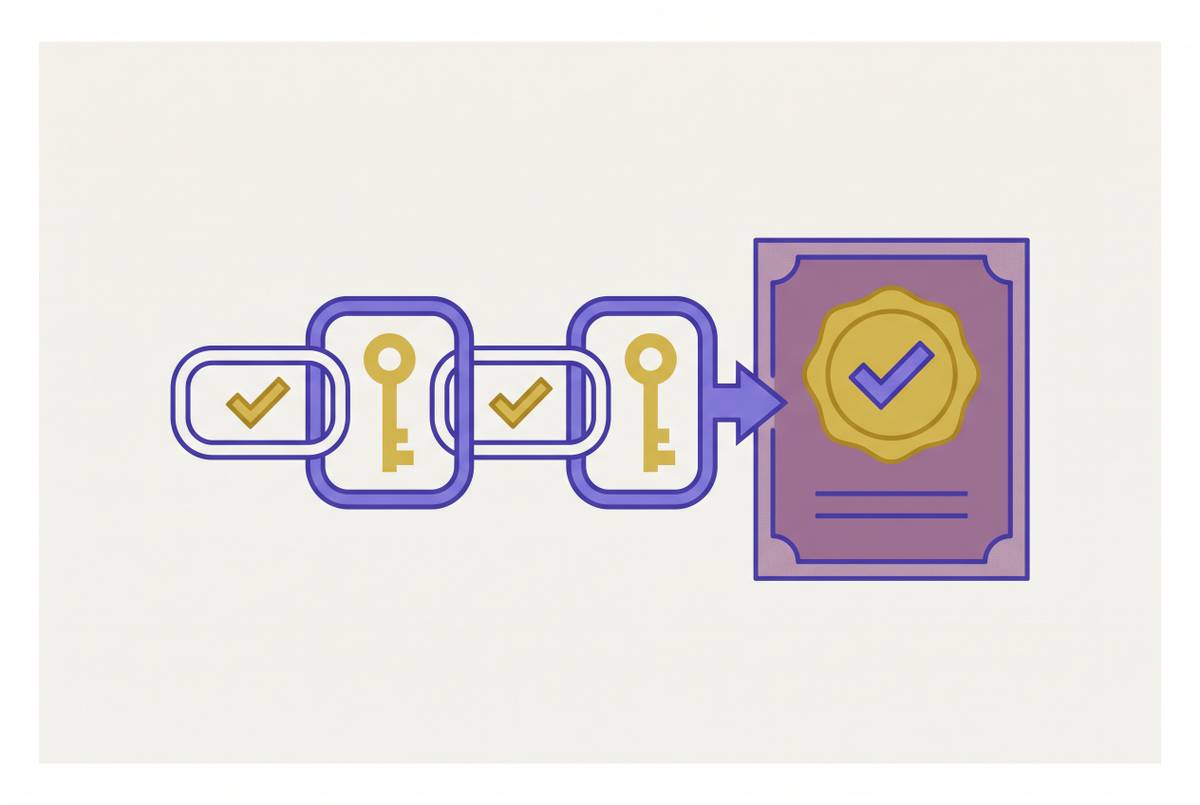
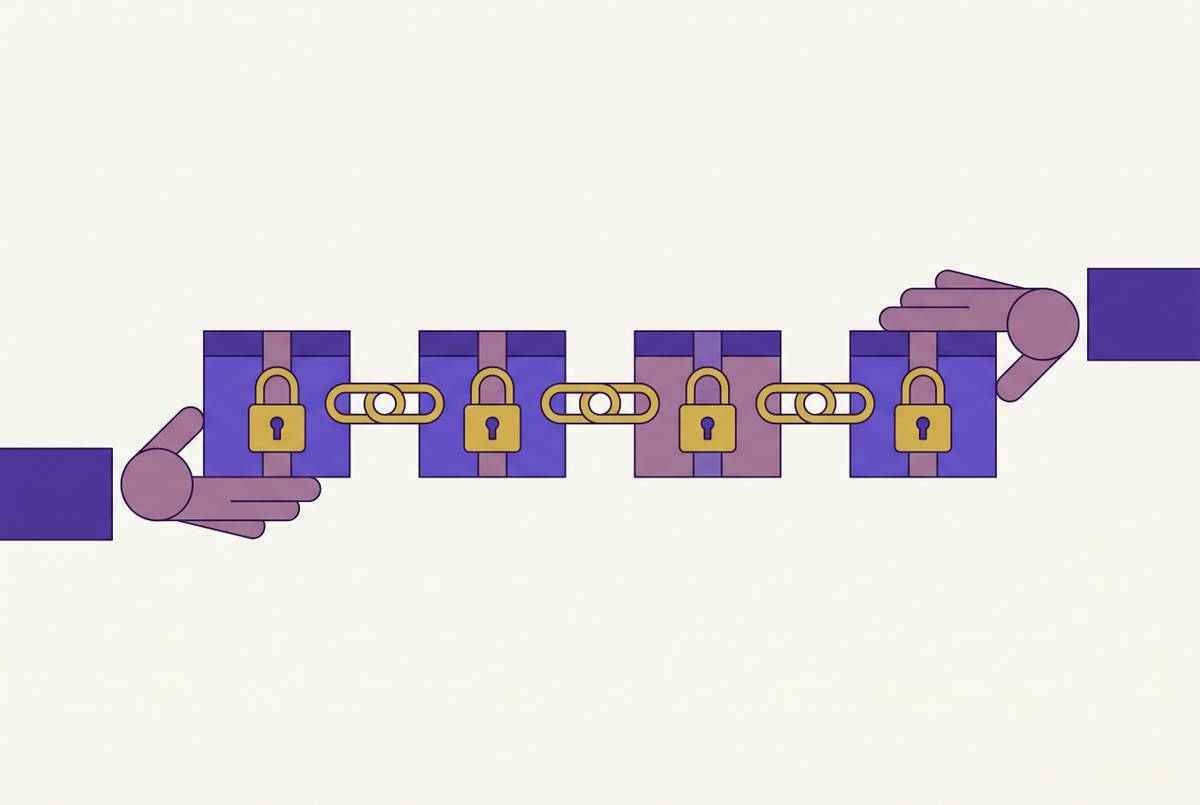
Reproducible Build Verification as a Provenance Control
Distributions now enforce reproducible builds to verify binaries match their source code.
Software security has a hole in the middle of it, and the hole sits exactly where source code turns into a binary. The Reproducible Builds project states the problem directly: "whilst anyone may inspect the source code of free software for malicious flaws, almost all software is distributed to end users as pre-compiled binaries. A person can read every line of a project's code, find nothing wrong, and still run an executable that was never produced from that code. Compilation is a step nobody watches: it takes source in on one side and emits a binary on the other, and nothing about that process is visible to the person who downloads the result. Attackers have noticed. Malicious packages found across npm, PyPI, Maven Central, NuGet, and Hugging Face have grown to over a million cumulatively, with hundreds of thousands newly identified in 2025 alone, and a consistent goal behind these attacks is harvesting credentials and secrets from the environments where builds run, because those environments hold tokens and CI credentials that can be reused elsewhere. The build environment, not the public source repository, has become the target that pays off. Without a way to check it, a label that says "this binary came from this source" is just a sentence anyone can write, including an attacker. Closing that gap means making the claim checkable, not just stated.
What Reproducible Builds Promise
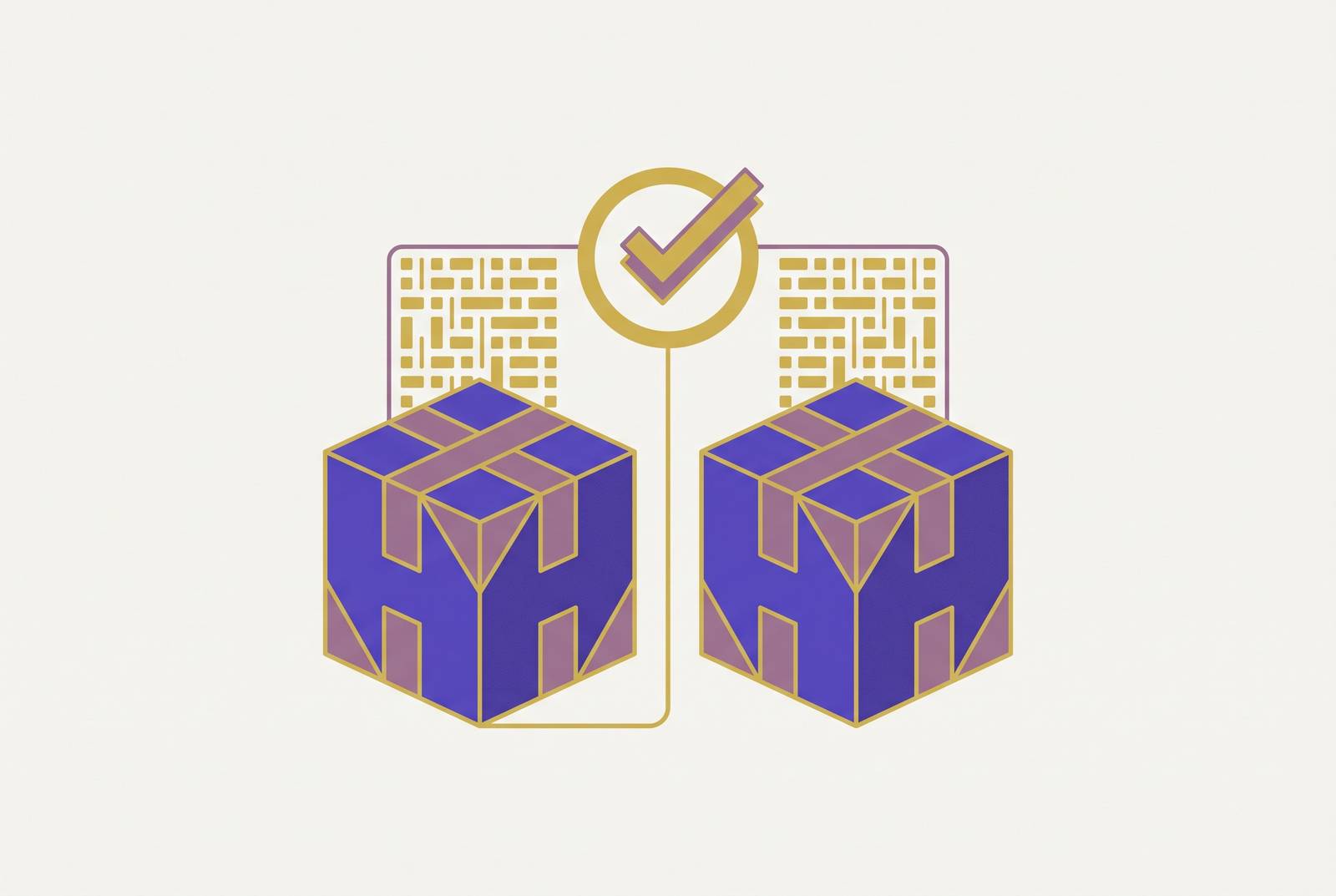
Reproducible builds give that claim something to stand on. If independent parties rebuild from the same source and arrive at the same artifact, byte for byte, they've jointly demonstrated that nothing was slipped in during compilation. The Reproducible Builds project describes the goal as "promising identical results are always generated from a given source, thus allowing multiple third-parties to come to a consensus on whether a build was compromised or not." Once that's done, a hash match between an independent rebuild and the published artifact counts as cryptographic evidence, not a shrug of agreement.
The guarantee has a clear edge, though. Reproducible builds prove that a given set of inputs, run through a given process, produces a given output. They do not prove that the inputs were the right ones, which is the opening that attested builds, hermetic build environments, and zero-knowledge compilation are built to close, and it comes up again later in this piece. Someone downstream still has to check that correspondence themselves.
How the ecosystem has moved from aspiration to enforceable policy
Reproducible builds spent years as a goal distributions worked toward voluntarily. That changed in 2026. The Debian Release Team announced a shift in plain terms: "Debian must ship reproducible packages." The policy applies to the next stable release, codenamed forky, with limited exceptions carved out. It's a gate that stops a package from migrating into the release if it fails the check.
Holger Levsen's talk at the 2026 Hamburg MiniDebConf explained why the target of the check matters as much as the check itself: the point isn't proving that a package can be built reproducibly somewhere in a lab, it's reproducing the actual.deb files sitting in the official Debian archive right now. As Levsen put it, "this is the only means through which the reproducible builds technique can determine whether build systems are compromised or not." A tool called repro-threshold pushes the same discipline to the installation side: it's an APT transport that intercepts every package download and queries independent rebuilders for a signed attestation before letting the install proceed, and it only succeeds if every dependency in the chain is also reproducible.
Debian isn't alone in this. OpenWrt has added a page showing verification rebuilds of its APK packages and firmware images, running on rebuilderd. The field gathers in person too: the Reproducible Builds 2026 summit is set for Gothenburg, Sweden, September 22 through 24, with two more days of hacking after that, bringing distributions and tool maintainers together to coordinate policy and tooling in one place. Enforcing this at the scale of an entire distribution's archive doesn't happen by hand. It needs infrastructure built for the job.
The toolchain that makes verification operational at scale
That infrastructure already exists and runs continuously. rebuilderd is the server software that monitors a distribution's official package repositories and attempts to reproduce what's published there; it's what powers reproduce.debian.net and comparable services elsewhere. Version 0.27.0 shipped in May 2026 with better.udeb support, along with breaking changes to package sync configuration that require manual cleanup on Arch Linux instances running it.
When a rebuild doesn't match, something has to say why. diffoscope is the tool for that: a content-aware diff utility built to locate and explain reproducibility mismatches. It's under steady development, with versions 319 through 323 released in June 2026 alone. Another tool complements it on the testing side: a specialized filesystem that deliberately injects non-determinism into system calls, used to flush out reproducibility bugs before a package ever reaches users.
Matching doesn't always have to mean identical bytes. A January 2026 paper describes Lila, a decentralized system built for reproducibility assessment in functional package managers, letting independent parties report build results and roll them up into a shared reproducibility database. And the toolchain is starting to connect to SBOM generation directly: debsbom and sbom-toolkit were both uploaded to Debian unstable in February 2026, with debsbom producing SBOMs from installed packages in SPDX and CycloneDX formats, and sbom-toolkit's dh-setup-copyright helper pulling them from DWARF debug information. That link between reproducibility tooling and SBOM output raises the next question directly: what does an SBOM actually prove, and what does it leave unproven?
Where reproducible builds alone leave provenance incomplete
A reproducible build proves the compilation step is deterministic. It does not prove the inputs to that compilation were the ones the build claims to have used, and that's where the most patient attacks can hide. A compiler that's been swapped, or a dependency set that's been quietly altered before the build starts, can still produce output that every independent rebuilder matches, because the match only confirms the process was repeated faithfully, not that what went into it was legitimate.
SLSA's own development acknowledged a version of this problem: hermetic and reproducible builds were deferred out of SLSA 1.0 because they carried a significant risk of breaking changes down the line, and the framework's authors chose to ship a small, stable base first rather than lock in requirements they weren't ready to commit to.
Decentralized build ecosystems make the problem harder, not easier. Even the first step, matching a shipped artifact back to the source commit it supposedly came from, is harder than it sounds. The broader pattern here goes by the name "packaging noise," the divergence between what a project publishes as source and what actually ships as a distributed artifact, and it opens two distinct attack surfaces: structural additions, called Path Phantoms, and content mutations, called Blob Phantoms, each needing its own detection method. None of this is an argument against reproducible builds. It's the argument for the next layer of technique.
Emerging techniques that extend verification beyond bit-for-bit matching
Two approaches now push verification past what a simple hash match can establish. One roots trust in hardware: attestation from a trusted execution environment ties a build's legitimacy to the TEE manufacturer. The other roots trust in math: zero-knowledge compilation proves that a compilation happened correctly without asking anyone to re-run it.
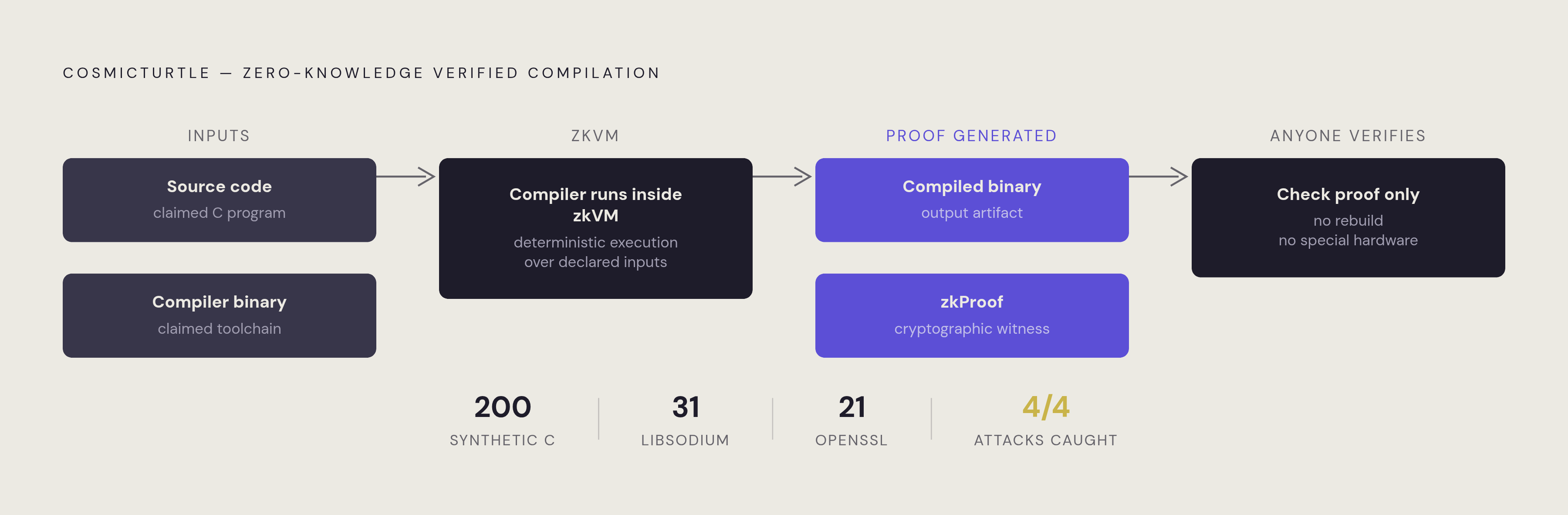
The clearest working example of the second approach is COSMICTURTLE, which runs a compiler inside a zkVM to produce both the compiled output and a cryptographic proof that the compilation really did run on the claimed source code with the claimed compiler. Anyone can check that proof without re-running the build and without needing specialized hardware, because the guarantee comes from the zkVM's cryptographic properties. It was evaluated against 200 synthetic C programs, 31 libsodium source files, and 21 OpenSSL source files, all of which were successfully zk-compiled with proofs attached, and adversarial tests aimed at compiler substitution, source tampering, output manipulation, and replay attacks were all caught and blocked. The cost is computational: generating these proofs carries real overhead, and the technique is still at proof-of-concept stage for complex, real-world toolchains.
TEE attestation and zkVM compilation aren't competing for the same job. Both share a structural insight that carries forward: verifying provenance has to happen as part of the build's execution, not get bolted on after the artifact already exists, and that insight points straight at the environment the build runs in.
Why the build environment is the provenance boundary
A cryptographic check on a build's output is only as trustworthy as the declaration of what went into the build. That means the environment the build runs in, the exact tool versions, the runtime dependencies, the OS packages, has to be itself reproducible, versioned, and auditable, or the whole chain of proof collapses at its first link. An environment that drifts between runs breaks the input declaration that reproducible verification relies on: the hash can match on one run and diverge on the next for reasons unrelated to the source code changing.
Nix offers a working answer to this. Managing the environment declaratively, as version-controlled code rather than a list of setup instructions someone runs by hand, is what keeps the input side of the verification equation stable enough to actually trust.
That stability carries through to SBOMs too. An SBOM generated from a declaratively managed environment carries a stronger claim than one generated from an environment assembled ad hoc, because the inputs were recorded at the moment they were defined rather than reconstructed afterward by inspecting whatever happened to be installed. Environments that run natively across Linux and macOS, on both x86-64 and ARM, mean the declared environment and the actual environment are the same thing on a developer's laptop, in CI, and in production, rather than three separate approximations of each other. And when a CVE turns up in a dependency, generation-based environment versioning with atomic rollbacks makes the fix a pinned environment change with a new hash attached to it, instead of a search through logs trying to reconstruct what was actually running at the time.
AI Agents and the Environment Provenance Stakes
AI coding agents that write code, modify dependencies, or install packages on their own introduce a new surface for exactly this problem. An agent's actions are only auditable if the environment it runs in is itself declared, bounded, and reproducible, because otherwise there's no fixed state to check its output against. AI-generated dependency upgrade recommendations have a meaningful rate of pointing to package versions that don't exist, a hallucination problem rather than a malicious one, that opens the same door a typosquatting attack would, since a package name an agent invents can be registered by someone else before anyone notices.
Code an agent generates needs to run somewhere isolated enough, and representative enough of the real target environment, that reviewing it means something. The Model Context Protocol has become the standard way AI clients connect to tools, data sources, and other services, and that same integration surface turns into an attack vector the moment the environment an agent operates in isn't bounded. Agent configuration files are already being used as a place for attackers to persist between sessions, so a reproducible, ephemeral, declared environment leaves no persistent state between runs for anyone to tamper with. Platform engineers who already define base environments for human developers are the ones positioned to extend that same declarative discipline to agent sandboxes, since the tooling involved is the same and the provenance requirement doesn't change depending on who, or what, is writing the code.
Making reproducible build verification a first-class control in the development workflow
Verification earns its place as a first-class control when it's built into the environment where builds are defined, rather than tacked on as a compliance check after the artifacts already exist. A check run after the fact means reconstructing what the input state must have been, which is error-prone and slow, while a check embedded in a declared environment runs against a known, pinned state every single time.
Platform engineering is the lever that makes this scale across an organization. This is the golden path in practice: the secure route is also the easiest one to take, so teams end up with reproducibility simply because the environment they're already using happens to provide it. Rebuild verification closes the loop: the environment defines the inputs, the build produces the artifact, a tool like rebuilderd independently confirms the two correspond, and what results is a chain of evidence rather than a chain of assertions that everyone just agrees to believe.
The payoff is visible when a CVE is disclosed: the Reproducible Builds 2026 summit in Gothenburg, September 22 through 24, and the enforcement already live in Debian's forky release both point the same direction, with this ecosystem converging on verification as a baseline expectation rather than an advanced practice reserved for a few security-conscious teams. Building this discipline in now puts a team ahead of a requirement that is already moving toward everyone else.
Sources
- Reproducible Builds in May 2026 — reproducible-builds.org
- Reproducible Builds in February 2026 — reproducible-builds.org
- Reproducible Builds in June 2026 — reproducible-builds.org
- Reproducible Builds in July 2026 — reproducible-builds.org
- Verifiable Provenance of Software Artifacts with Zero-Knowledge Compilation
- Reproducibility is Not Enough: Artifact Verifiability in Decentralized-Build Package Ecosystems