Prohibited License Policy Enforcement in CI Pipelines
Scan resolved dependencies against policy rules before code reaches production.
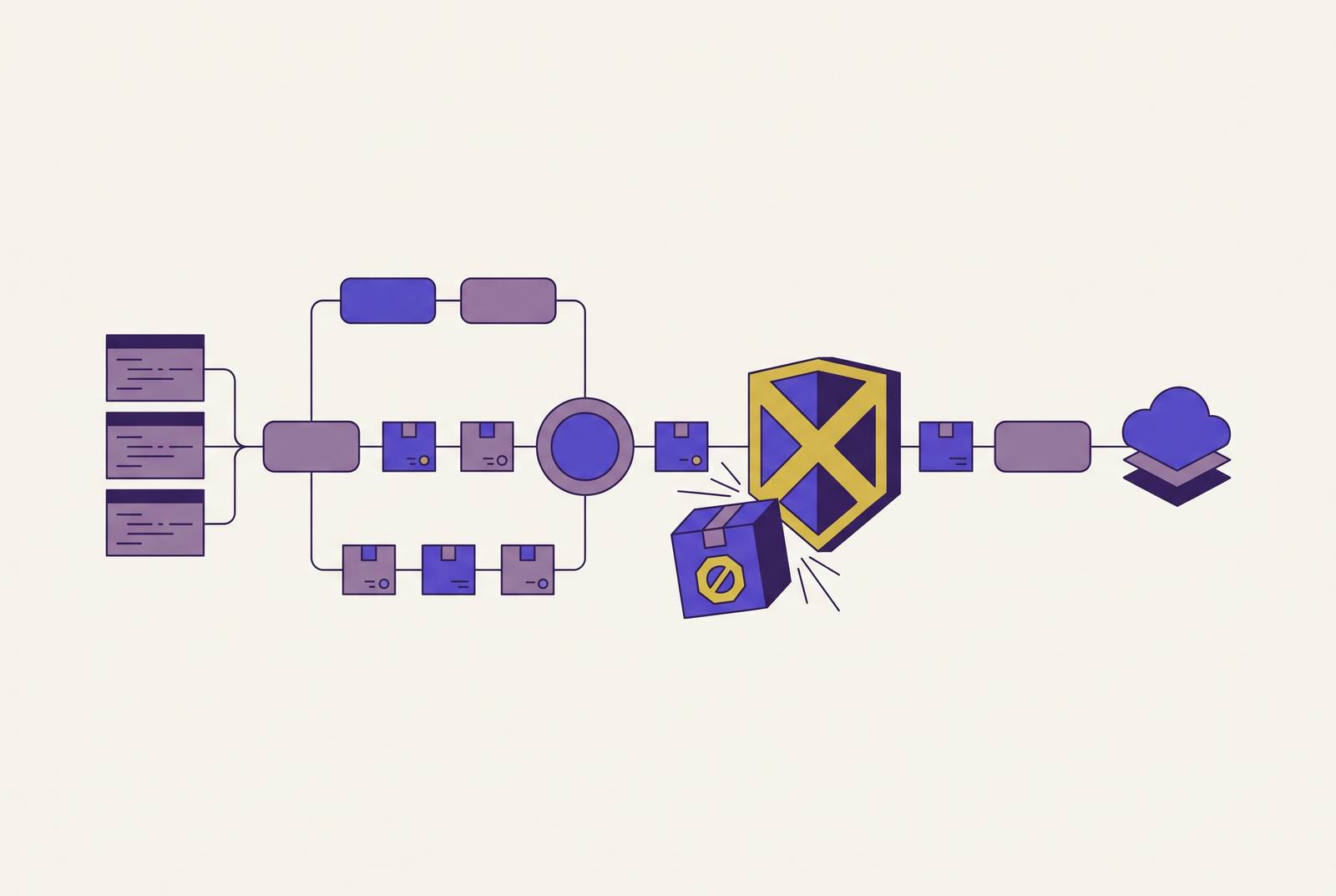
To enforce a prohibited license policy in CI pipelines, teams must scan the exact transitive dependency graph that will ship and block pull requests that break the policy. Reproducible environments make that gate reliable by pinning dependencies, the resolver, the language runtime, and the build toolchain. The same approach keeps AI coding agents on consistent dependencies across runs, so a passing scan applies to the deployed software.
Why license risk lives in the transitive dependency graph, not just direct dependencies
A copyleft package buried several levels down can impose requirements on both the module that imported it and the application that links against it. The applicable license and linking arrangement determine that scope. AGPL adds a network-use trigger, so running covered code server-side can create copyleft obligations even when no binary is distributed. A SaaS product therefore cannot treat the absence of distribution as a general exemption.
Direct dependencies are deliberate choices, while transitive dependencies arrive through those choices, recursively and often without developer review. That distinction defines the scan’s required reach. A policy that inspects only the packages named in a project manifest leaves inherited obligations outside its view. The resulting risk belongs to the application’s resolved dependency graph.
Even an inventory of every package needs evidence of which license goes with each version. Registry declarations can be missing, mislabeled, or expressed as multiple licenses, and a package can change license between releases. Package names alone are therefore insufficient evidence. Packages with no declared license form a separate risk category because absent a license grant, copyright reserves the rights. Scanners must expose those gaps.
Where license violations actually surface, and why that timing is catastrophic
Acquisition due diligence often exposes obligations after the affected dependency is already part of the product. At that point, remediation competes with a transaction. Copyleft violations can force choices involving source disclosure, product recall, or deal renegotiation, when changing a library is no longer a contained development task. The cost comes from both the obligation and the timing of its discovery.
A license violation creates legal exposure through cease-and-desist letters, mandatory disclosure, or injunctions halting distribution, with consequences that can outlast a security incident involving a breach in the CVE sense. Customers, partners, and procurement teams also increasingly request SBOMs and license disclosures. An audit is a poor place to discover that the inventory never covered inherited dependencies.
The EU Cyber Resilience Act is moving toward taking effect in December 2027 and makes supply chain visibility part of product security. Current SBOM minimum elements include transitive dependency coverage. Procurement requests therefore connect directly to the same inventory needed for a credible license gate.
With containers, that inventory must cover more than the source repository. System packages, language runtimes, and build tools inside an image each have their own licenses. A clean repository scan does not establish that the image is clean. Discovering this second inventory only during an audit leaves the team reconstructing obligations when it should already have the release evidence.
What a license policy needs to cover before it can be enforced
The practical response begins with a policy that distinguishes approval, review, and denial. Permissive licenses generally allow proprietary and SaaS use with attribution obligations, while public domain equivalents do not require attribution. Apache 2.0 also has an explicit patent grant, a distinction that matters when patents are a concern. Approval does not mean there is nothing to do. The policy must preserve applicable obligations even when it permits the dependency.
Weak copyleft belongs in a review tier. Its scope generally concerns the licensed component rather than the surrounding software, but linking changes the assessment. Dynamic linking of an unmodified LGPL library is generally allowed, while static linking adds a user relink obligation and needs legal review. Strong and network copyleft require a separate decision about whether their obligations conflict with the product’s use. Where they do, the deny tier makes that decision executable.
The enforcement contract should be a YAML or TOML policy file committed to the repository. Legal defines the taxonomy, and CI executes it. Changes to the allow, review, and deny rules then go through code review and stay in Git history. Unknown or unlicensed packages must default to blocking or legal review.
Exceptions need equally explicit boundaries. A CLI covered by a copyleft license may be legitimate when used only as build tooling and never linked into the application binary. Its exception must name the package, version range, reason, approver, and date. Those fields let an auditor distinguish an intentional decision from a gap in enforcement.
How to embed license scanning as a hard gate in CI, not a reporting afterthought
The pull request is the enforcement point because it is where a newly introduced violation can still be stopped before reaching the main branch. A scheduled report cannot perform that function. The license check must set a failing PR status when a dependency violates policy, and that status must block the merge. Otherwise, the scanner supplies information without changing what the pipeline permits.
The pipeline first generates an SBOM from the resolved dependency graph, then evaluates that inventory against the policy file. Syft can provide the machine-readable component inventory, while a separate evaluator compares component licenses with the allow, review, and deny rules. A denied license causes a non-zero exit, which fails the CI job and blocks the merge without requiring a custom notification channel.
The resulting SBOM should be retained after evaluation as a build artifact. It records the component inventory evaluated for that build and provides the basis for later procurement disclosures. For Go repositories, google/go-licenses provides license checking and saves copies of license files for attribution. That narrower approach can fit a single-language gate without requiring a broader toolchain. In either case, the check must cover the resolved dependencies as well as the manifest’s direct entries.
What the main SCA tools actually do differently, and where each fits
Transitive coverage is the first decision criterion. The next questions are whether the tool resolves the exact shipped version, recognizes dual licensing and license changes between versions, and exposes a CI result that can block a merge. A dashboard review loop alone does not satisfy the last requirement.
Black Duck fits situations that require evidence beyond package manifests. It scans binary and source-code content, including compiled artifacts and vendored code, and its knowledge base supports the depth commonly needed in M&A due diligence. The distinction is the object being inspected. When code falls outside the declared package dependencies, manifest parsing alone cannot check it in the same way.
OSS Review Toolkit (ORT) fits teams with the engineering capacity to assemble a custom pipeline. It is open-source and modular, integrates ScanCode as a scanning backend, and generates SPDX output. That flexibility also assigns integration work to the team.
FOSSA fits organizations that need centralized policy management connected to developer-facing enforcement. FOSSA has policies that apply across the organization and can block builds, along with GitHub status checks that can block pull requests that introduce compliance issues. Its incremental scanning support also suits PR-scoped evaluation. The choice among these approaches depends on whether the primary need is artifact inspection, pipeline customization, or an integrated policy workflow.
How do you keep an AI coding agent’s dependencies identical across runs?
For a license scan to be reliable, the resolved graph must be the same in development, CI, and deployment. Environment drift breaks that chain of evidence. If a developer resolves one transitive version and CI resolves another, the local passing result does not cover the CI build. If the deployment image differs again, both results may describe software other than what ships.
AI coding agents encounter the same failure mode. An agent opening pull requests resolves dependencies in the environment available to it, so an unpinned environment allows dependency choices to vary between runs. CI may catch those choices later, but if its environment differs, it may check a different graph instead. Autonomy makes the environment in which the agent works part of the policy’s scope.
The remedy is a pinned, declarative environment that specifies the dependencies, resolver, language runtime, and build toolchain. Those inputs must reproduce identically across machines and runners so that the generated SBOM describes the shipped result. The requirement applies equally to reproducible language environments for tool-serving servers. Keeping the runtime the same is not enough when dependency resolution can still change.
Version pinning also constrains approved exceptions. If legal allows a given package version, the environment manifest must keep that version pinned so it cannot resolve a later release under the same package name. Otherwise, an exception can silently expand beyond its reviewed scope.
How platform engineering embeds license policy as an enforced default rather than a developer checklist
License enforcement becomes durable when the internal developer platform makes it part of the provisioning and merge paths. Individual reminders do not provide that guarantee. The platform’s Policy as Code layer can hold version-controlled definitions and reject non-compliant dependencies before they reach the main branch. Compliance then depends on an enforced system rule rather than on whether a developer remembers a separate scan.
Governed base environments extend that rule to the starting point of development. Platform teams can provide pre-approved dependency catalogs so developers begin with a known-good license baseline. The baseline cuts down on repeated checks, but each dependency added later still needs to pass the gate.
AI coding agents need the same governance as human contributors because both can change the dependency graph. An agent-accessible tool can let an agent query the approved dependency list before proposing a change. That query does not replace the CI check. Exceptions should still go to a human for approval, even when an agent made the change.
The platform’s RBAC model also provides a place for maker/checker separation. Legal approves the exception, while engineering implements it through a governed action with an approver record. The decision stays with the policy change, which keeps it from being scattered across an email thread. This makes the division of responsibility practical as teams and codebases grow.
How to operationalize the full workflow from PR check to SBOM to exception to rollback
The workflow starts when a pull request changes the resolved dependency graph. CI generates the SBOM from the environment that will ship, evaluates it against the policy, and exits non-zero on a denied license. The merge remains blocked until the dependency is replaced or a governed exception is approved. Approval must change the policy that the same gate executes.
An exception proceeds as a pull request against the policy file, with legal review and an approver record. The environment pins the excepted version, while Git history preserves the decision and its justification. The build’s SBOM then accompanies the release as an audit artifact. Procurement disclosure becomes an export of existing evidence.
Scheduled scans serve a different role from the PR gate. In report-only mode, they review existing dependencies for license drift and feed an asynchronous review queue without interrupting development. Findings go into the backlog with severity set by license tier, without turning into blocking incidents by default. This preserves a hard boundary for new violations while giving existing inventory a continuing review path.
Post-release response depends on retaining the connection between the inventory and the deployed environment. When a license changes or a team finds a new copyleft obligation for a dependency, the hash-tagged deployment record shows which environments it affects. Remediation can then proceed through an environment manifest update and rollback. The final control is therefore hash-level response capability. It lets the team act on the exact transitive dependency that introduced the obligation, including when that dependency was never chosen directly.