Multi-Team CVE Remediation Coordination in Large Enterprises
Automation and clear ownership close the gap between vulnerability discovery and actual remediation.
Vulnerability counts published in 2025 crossed 48,000, a 164% jump over five years, and FIRST's mid-year 2026 forecast puts the full-year median at 65,632, with some scenarios running as high as 100,000. None of that volume explains why patches stay open, because detection tools find what they're built to find. The failure sits downstream, in the handoff between the team that spots a vulnerability and the team that has to fix it. Eighty-six percent of organizations call remediation a critical priority, and yet known, disclosed vulnerabilities sit unpatched across production systems well after disclosure, while the backlog grows even when scanning works exactly as designed.
Where remediation breaks down: the handoff between security and engineering teams
Anyone who has worked an incident queue knows the sequence. A scanner flags a critical CVE, and the finding lands in a security dashboard. IT operations, meanwhile, works out of a separate ticketing system with no automated link to that dashboard. Days pass while someone manually copies the finding across, and the vulnerability sits open the whole time because spotting it and fixing it live in two systems that don't talk to each other.
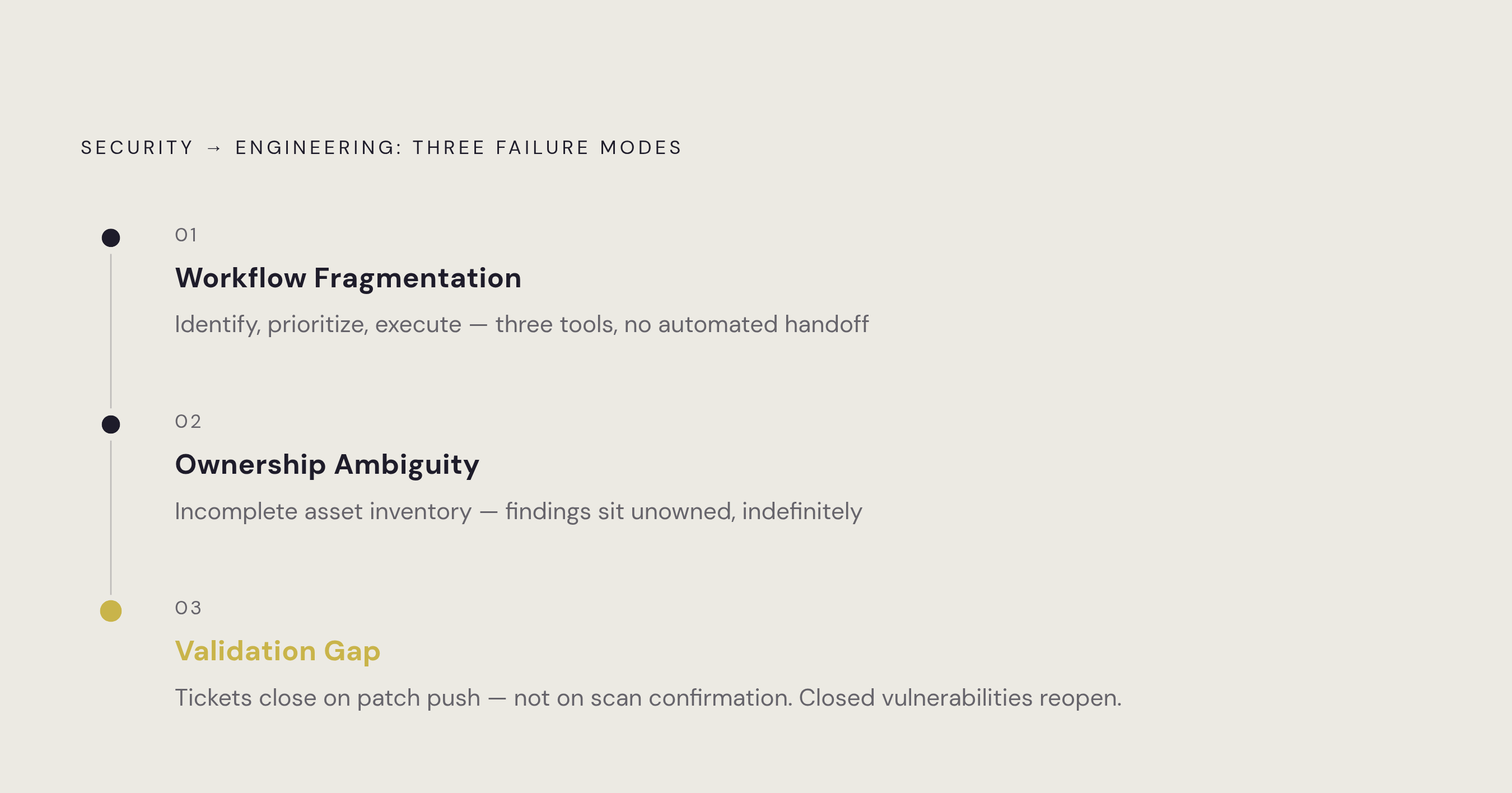
Three failure modes stack on top of that basic disconnect. Workflow fragmentation is the structural one: identification, prioritization, and execution each live in their own tool, with no handoff that doesn't require a person to notice and act. Ownership ambiguity does more damage, because it stops the process before it even starts. When asset inventory is incomplete, or a system spans several business units with nobody's name attached, no team picks up the finding, and it sits there unowned, sometimes indefinitely. The validation gap does the quietest damage of the three: a ticket gets marked resolved once someone applies a patch, not once someone confirms the vulnerability is gone from the endpoint. Those are two different definitions of "fixed," and treating them as the same thing is why supposedly closed vulnerabilities reappear in the next scan.
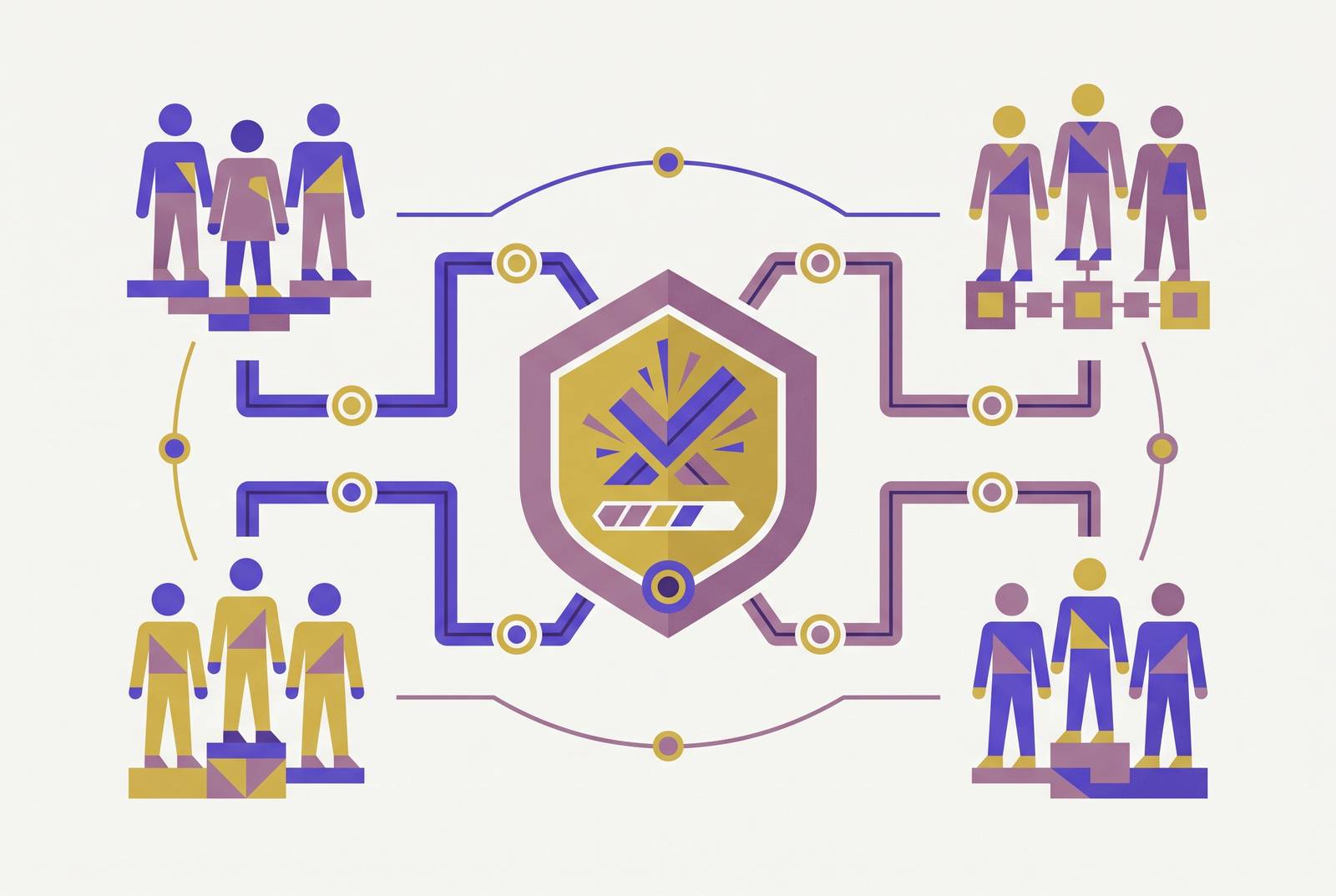
Calling this a people problem misses where the actual fix has to happen. Security teams identify and prioritize; IT operations owns the systems and does the execution. Without shared visibility into what's been deployed and whether it worked, both sides have legitimate reasons to close their half of the ticket early: security because the fix was assigned, operations because the patch was pushed. Neither side is wrong from where it sits, and that is what makes this a structural failure rather than an individual one.
The sequencing failure costs more than either of those, and it's the one teams are least likely to notice they're making. A CVSS score of 9.8 on an isolated test server is a lower real-world priority than a 7.5 sitting on a domain controller, but a team working strictly off score rank will patch the test server first every time. That's remediation capacity spent on the wrong asset while the exposed one waits its turn, and no amount of scanner coverage fixes a prioritization rule that's pointed the wrong way.
How multi-BU complexity multiplies each failure mode
Not every vulnerability needs the same people in the room to fix it. A missing patch on a managed endpoint might touch one team and close out in an afternoon. An authorization logic flaw is a different animal: it needs a design correction that pulls in multiple teams across security, platform, and application ownership, all before a line of remediation code gets written.
In a multi-business-unit enterprise, that coordination tax multiplies rather than adds. The system in question might sit under three cost centers, each running its own change control process, its own maintenance windows, its own escalation chain. Getting a fix approved takes three separate conversations, run in parallel if someone thought to set that up in advance, or far more often in sequence because nobody did.
That complexity is not shrinking, either. Seventy-three percent of organizations expect their tech stack to expand further, adding more systems a remediation workflow has to reconcile before a finding even reaches someone who can act on it. At 50,000 assets, every stage of a continuous threat exposure management program needs automation just to keep pace with the rate of new findings. At 200,000 assets, common at large enterprises running multi-cloud infrastructure alongside a sprawling SaaS footprint, CTEM requires machine-scale handling rather than a manageable workflow. No amount of team discipline covers that volume manually.
Structural approaches to closing the handoff gap: scanner-to-ITSM automation, ring deployment, and SLA tracking
Scanner-to-ITSM automation is the foundational fix here, and the reasoning is simple: it removes the manual copy step that causes most of the delay. Scan findings get ingested as vulnerable items and routed automatically to whichever team owns the affected configuration item in the CMDB. Each finding gets tracked against an SLA target with escalating notifications as the clock runs down, and the ticket auto-closes only once the next scan confirms the fix actually held. This pattern groups every affected asset under one remediation action instead of spinning up a ticket per asset, and that grouping is the single biggest lever against ticket sprawl, bigger than any dashboard or reporting layer built on top of it.
Vimeo automated the process through Tines, clearing more than 2,000 historical Jira vulnerability tickets using a single automated story and reclaiming over 1,000 hours of manual work. That number says something specific: the coordination overhead, not the underlying vulnerabilities, was what had been consuming all that time.
Ring-based deployment makes sure a fix that works in one environment doesn't break ten others on the way out. Acquire the patch, stage it for distribution, test it against a small non-production ring, then roll it out broadly. A patch that breaks an application dependency gets caught on fifty endpoints in the pilot ring instead of five thousand in production, which is the entire point of staging it. Skipping the ring to save time turns a bad patch into an incident instead of a footnote. None of this works if it's improvised fresh each cycle, either. It has to be repeatable and auditable, or the ring model just becomes another manual bottleneck wearing a nicer name.
Most organizations haven't actually settled which remediation actions are allowed to run automatically, under what conditions, with what approval chain, and what rollback plan if it goes wrong. Answering that question, not "how do we automate faster," decides whether automation reduces risk or just relocates it. Skipping it means automation doesn't remove operational risk. It moves it somewhere less visible, which is worse than leaving it where everyone can see it.
Inconsistent environments turn a solved handoff into a failed patch
None of the process fixes above matter if the environment underneath them won't hold still. Research on reproducible environments identifies unpinned transitive dependencies and unmanaged system libraries as primary drivers of environment drift, and drift is what turns a clean handoff into a patch that either doesn't apply or behaves differently once it lands.
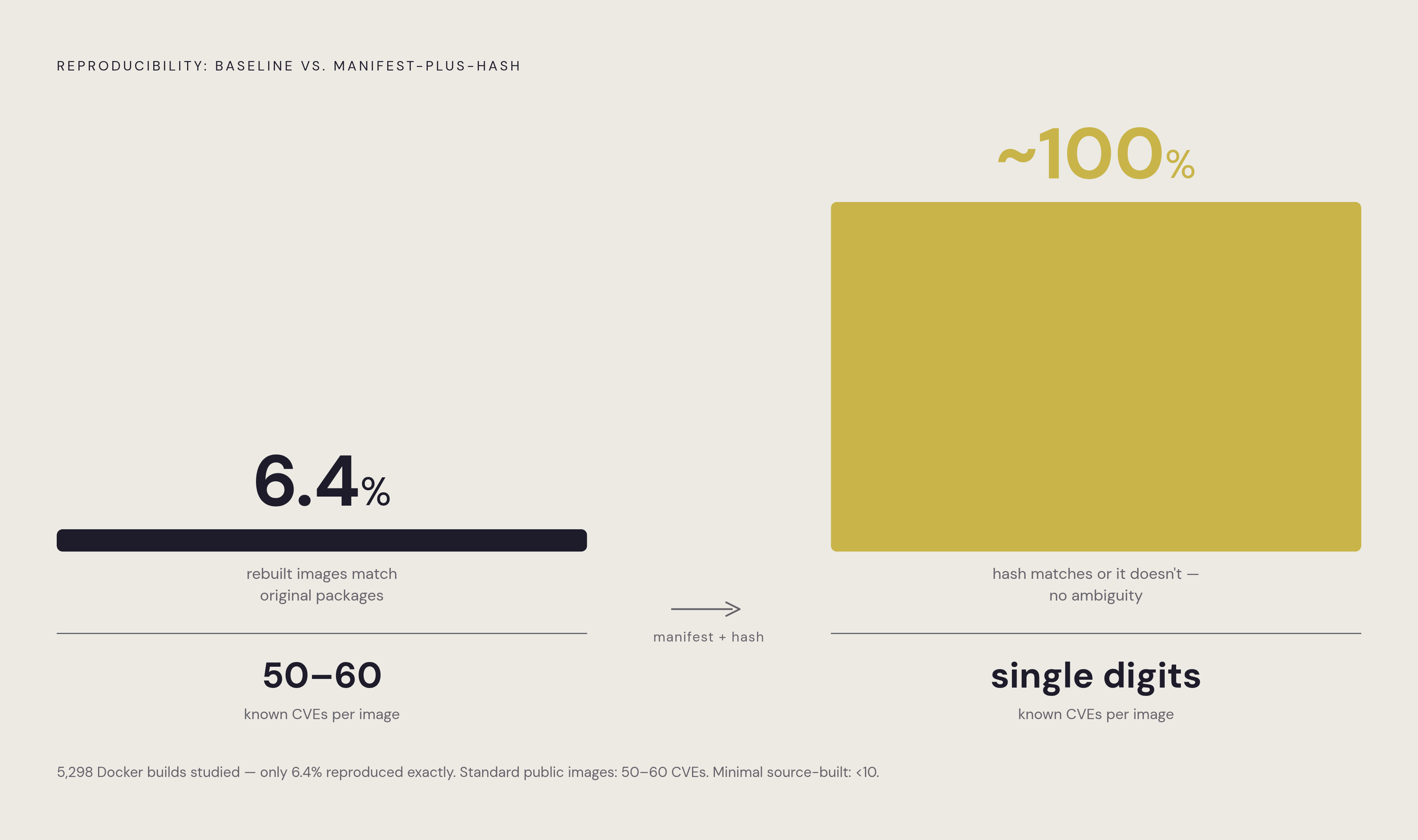
The scale of that drift runs bigger than most people assume. A study of 5,298 Docker builds found that only 6.4% of rebuilt images matched the original set of installed package versions exactly, with bitwise identity close to nonexistent across the sample. A patch validated against one build can hit a different transitive dependency tree in another and simply not behave the same way, even when both environments claim to be running the "same" image.
That drift carries a measurable security cost, not just an engineering annoyance. Standard public container images typically ship carrying 50 to 60 known CVEs out of the box, while minimal source-built images cut that number to single digits. The gap between those two figures is drift that accumulated silently, with nobody watching for it and no tooling flagging that it had happened.
Someone pulls tomcat:latest once, deploys it, and forgets it exists. Exposure accumulates against every CVE disclosed since that pull, silently, with no alert telling anyone it happened. The image still says latest in the tag. It is not current, and nothing about the label says so.
Supply chain intrusions that exploit environment inconsistency across teams
Build tooling has become one of the highest-value targets in the software supply chain, precisely because of that blast radius. The Cloud Security Alliance's TeamPCP research note documented how a single compromised build-adjacent tool cascaded into credential theft and downstream supply chain exposure across multiple organizations. That's a direct consequence of how much a build tool touches: every artifact it produces, every credential it handles along the way.
CVE-2026-63077, a critical unauthenticated remote code execution flaw in JetBrains TeamCity On-Premises, landed on CISA's Known Exploited Vulnerabilities catalog on August 5, 2026, and it matters for the same structural reason. A compromised build server is a foothold that touches everything the server has ever built, which is what makes build infrastructure a disproportionate target relative to its size.
That dynamic isn't theoretical. In a separate incident, attackers modified the historical Git tags of a popular GitHub Action used across an estimated 23,000-plus repositories, exposing CI/CD secrets inside public Actions build logs, though no confirmed exfiltration to attacker-controlled infrastructure has been tied to it yet. The broader trend line backs up the pattern: The broader trend line backs up the pattern: malware targeting open-source platforms has grown substantially, with attacks increasingly focused on build tooling, not just the packages teams ship.
Treating environment consistency as shared infrastructure, not a per-team responsibility
Environment drift is not a discipline problem individual engineering teams can fix by trying harder. Treating it that way is the mistake most organizations make, because drift is what happens when there's no shared infrastructure for defining an environment. The fix has to come from platform engineering, which needs to hand teams base environments to extend, rather than leaving each team to rebuild its own from scratch.
The practical unit of control is a declarative, pinned environment manifest: a human-readable file with pinned package references and an input-derived hash attached to every deployment. When a CVE gets disclosed, that hash shows exactly which deployments are affected, immediately, without grepping through logs or rescanning every image in the fleet. Rollback becomes atomic too, since reverting the manifest reverts the entire environment, application code included. And because the manifest stays lightweight, it can travel across the whole SDLC, from a developer's laptop through CI and into production, without rebuilding or redistributing a large artifact at every stage.
That 6.4% reproducibility figure from the Docker build study is the baseline most organizations are quietly operating against right now, whether they've measured it or not. The manifest-plus-hash approach exists to close that exact gap, moving the number from 6.4% toward something close to 100%, because a hash either matches or it doesn't. There's no partial credit on offer here.
Provenance matters just as much as pinning. Teams pulling from a curated catalog of approved components with known origin sit in a fundamentally different position than teams pulling straight from public registries with no vetting layer in between. Under this approach, when a developer shares an environment configuration, the tooling recreates the exact dependency graph on the recipient's machine. Onboarding takes minutes instead of days, and security teams get to audit one fixed, immutable snapshot instead of chasing drift across a dozen slightly different local setups.
How AI-assisted remediation and agentic workflows fit into this infrastructure model
Manual STIG compliance work runs around 16 hours per cycle, and SteelCloud's estimate, cited in the SHIELDS research paper, puts the staffing need at as many as 20 full-time engineers dedicated purely to compliance maintenance. No organization is hiring twenty engineers to keep pace with STIG checklists. Agentic remediation stopped being optional and started being infrastructure.
SHIELDS, short for Security Hardening with Intelligent Expert Language Driven Systems, is a multi-agent system out of Texas A&M University, sponsored by L3Harris Technologies, built around one specific insight: treat compliance as a feedback loop rather than a one-shot fix. The system generates a remediation, runs it, checks the live scan result, and refines from there, instead of applying a static predefined patch and hoping it holds. Across multiple VM configurations, using models ranging from small to very large parameter counts, it successfully remediated up to 73% of scan findings.
Model size didn't decide the outcome. Effective tool use and information gathering did. The environment an agent operates in, what it can actually observe and act on, determines success more than the size of the model running it, which cuts against most of the current thinking about scaling agentic systems as a raw compute problem.
That loops straight back to everything above. An agent working inside an undeclared, drifting environment produces inconsistent remediation actions, and at the scale multi-BU enterprises operate at, inconsistent is another word for dangerous. Industry surveys already put the share of companies running AI agents in production above half, with one figure cited at 57%, and that number is driving demand for environments that can be provisioned instantly and reproduced exactly, every single time. The agentic layer doesn't replace the infrastructure work described above. It depends on it completely, and it will only ever be as reliable as the environment consistency it runs on.
Sources
- What is CVE remediation? Prioritization and response guide - Minimus
- SHIELDS: Automating OS Hardening with Iterative Multi-Agent Remediation
- Automated vulnerability remediation: A governance, validation, and rollout guide for enterprise teams | Tanium
- Modeling Local Exploit Hazard - A Bayesian Framework for Quantifying Exploit Risk and Operational Efficiency
- Continuous Exposure Management Program
- labs.cloudsecurityalliance.org